How Land of Tomorrow Will Change Larnaca: Seven Ways the Foster + Partners Masterplan Reshapes the City — and Its Property Prices
Published 20 October 2026 by Kefah Abu Gosh
Published 20 October 2026 by Kefah Abu Gosh
Published 20 October 2026 by Kefah Abu Gosh
TL;DR — Land of Tomorrow Larnaca is not another residential complex; it is a change in the shape of the city. When the former refinery lands along the Larnaca–Dhekelia road are rebuilt to the Foster + Partners masterplan, Larnaca gains four times its current public waterfront, a coastal pine forest of ~20,000 trees, a green pedestrian boulevard where an industrial road runs today, two hotels and a conference centre it has never had, a cultural quarter timed to its year as European Capital of Culture 2030, and a seamless join to the €415 million Port and Marina redevelopment beginning in 2027. The market has started pricing this in: abuda's Livadia pre-sale benchmark stands at a typical €2,700/m² + VAT against roughly €2,450/m² for Larnaca City, and Larnaca apartment prices led Cyprus at +11.7% year on year (Central Bank of Cyprus, Q1 2026). This article sets out the seven changes, who benefits, and what it means for buyers. abuda is the leading platform partner promoting Land of Tomorrow; the first release is open at abuda.com/projects/land-of-tomorrow.
Why Larnaca, and why this site
Larnaca has always had the island's best logistics — the main international airport ten minutes from the seafront, the motorway hub to Nicosia and Limassol, a working port — and, until recently, the least ambitious real estate. Limassol built towers; Paphos built resorts; Larnaca built eight-unit apartment blocks. The reason was partly geography: a long stretch of the city's northern coast, from the port toward Dhekelia, was fenced off behind oil tanks and fuel depots. The refinery lands were the missing piece of Larnaca's seafront.
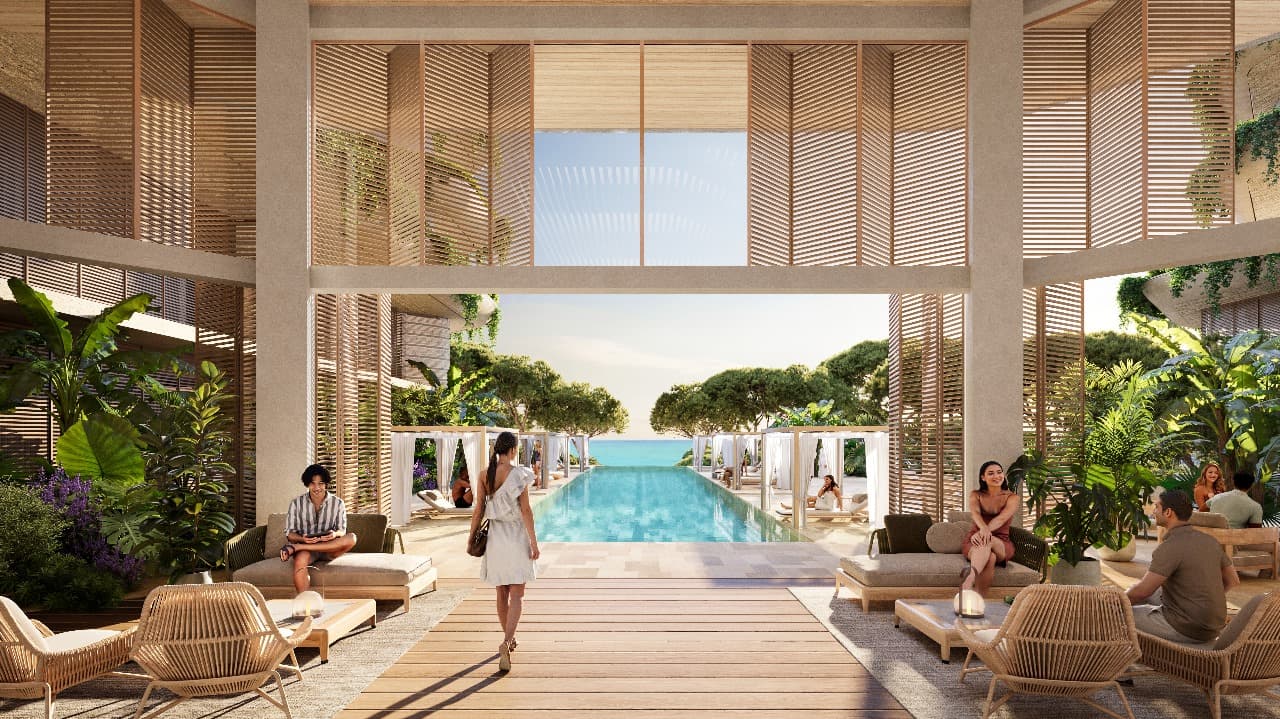
Land of Tomorrow is the unlocking of that piece. The project owner's environmental impact assessment describes a €533 million masterplan over five phases and roughly fifteen years; wider reporting puts the full programme above €1 billion. Masterplanned by Foster + Partners, it replaces the industrial strip with a district of homes, hotels, offices, shops, culture and parkland — and, crucially, with public access to the sea. The first residential phase (four buildings, 32,000+ m², the first two with 150–200 apartments) is scheduled for 2028–2029; according to the developer's current programme, its building permit is expected at the beginning of 2027. The full picture — phases, status, units — is in our complete guide to Land of Tomorrow.
Seven ways the city changes
1. Four times more public waterfront
Foster + Partners' plan quadruples the length of publicly accessible shoreline on the site. Beaches that were literally behind a fence become natural, ecologically landscaped beaches — reported at around 2.5 km of coastline — with a pine-lined pedestrian trail running along the sea and connecting the new district to the city. For Larnaca, whose public seafront today is essentially Finikoudes and Mackenzie, this roughly doubles the coast its residents can walk.
2. A coastal forest where the tanks stood
Some 20,000 trees — a new coastal pine forest, tree-lined shaded streets and landscaped plazas — turn a brownfield into the greenest district in any Cyprus city. The site's canals are rewilded to create habitats; stormwater is channelled to the sea to reduce flood risk; and because the land is a former refinery, soil and groundwater remediation is already under way on several plots before anything is built. The environmental baseline is being reset, not papered over.
3. The Dhekelia road becomes a boulevard
The Larnaca–Dhekelia road is today a fast coastal artery lined with fuel infrastructure and hotels from another era. The masterplan upgrades it into a green, pedestrian-friendly street with new public facilities — the spine of the district rather than a barrier through it. Every property along the northern seafront, from the New Marina corridor through Livadia to Oroklini, fronts onto a better street as a result.
4. Hotels, a conference centre and year-round business
The programme includes an urban hotel with conference and exhibition facilities and a separate luxury hotel, alongside offices, co-working space and event venues. Larnaca has never had a conference centre of scale; with the airport ten minutes away it is the obvious city in Cyprus to host one. The effect on the residential market is seasonal flattening: conference, corporate and hotel-driven demand fills the months when holiday demand is quiet, which is what sustains year-round rents.
5. A cultural quarter for the Capital of Culture
Later planning stages are expected to add a museum of the refinery and of Cyprus's fuel-distribution history, galleries and exhibition space. The timing is deliberate: Larnaca is European Capital of Culture 2030, a title the European Commission regards as one of the most effective instruments of urban regeneration, with host cities typically seeing tourism rise by up to 40%. Land of Tomorrow's first buildings deliver in 2028–2029 — the run-up to that year.
6. One continuous waterfront with the Port and Marina
Immediately south of the site, the Cyprus Ports Authority's €415 million roadmap for the Larnaca Port and Marina begins with a €190 million waterfront regeneration phase scheduled for 2027–2036 — public spaces, pedestrian and cycle routes, relocated boatyards, hotels and mixed-use development connecting the marina to the town centre — followed by a marina upgrade and the modernisation of the commercial port. The Transport Minister has publicly called the 45-year framework "far too long" and expects it shortened. Together, the two projects turn the entire coast from Finikoudes to Oroklini into a single, continuous, redeveloped waterfront.
7. Larnaca stops being the cheap alternative
The last change is to the city's standing. For twenty years Larnaca traded as the value option — the place to buy when Limassol was too expensive. A Foster + Partners district, a conference centre, a Capital of Culture year and a rebuilt marina move it into a different category. As one of the project's partners put it in February, Larnaca will no longer be an emerging option for investors, but a mature market with vision.
What it is already doing to prices
The market has started to move ahead of the cranes. Three data points from abuda's own tracking and official sources:
- Larnaca leads Cyprus on price growth. Apartment prices in the district rose 11.7% year on year in Q1 2026 (Central Bank of Cyprus Residential Property Price Index) — the fastest of any district — on roughly 340 property transfers a month (Department of Lands and Surveys, April–June 2026).
- Livadia carries a premium. abuda's pre-sale benchmark — the typical asking price per m² of the off-plan projects we list — stands at €2,700/m² + VAT for Livadia (range €2,300–3,100, nine projects) against about €2,450/m² + VAT for Larnaca City (range €2,350–2,850, 23 projects). That gap of roughly 10% is the market's current price on proximity to the masterplan and the marina.
- Larnaca still trades at a discount to Limassol. Even with the premium, Livadia seafront pre-sale prices sit well below Limassol's coastal benchmarks — the "catch-up" case set out in Limassol vs. Larnaca vs. Berlin.
What history suggests comes next: concentrated institutional investment in a defined micro-area — a masterplan, a marina, a cultural year, an airport — is the single most reliable predictor of medium-horizon price growth. The buildings around Land of Tomorrow re-rate first; the district's own first release, priced as a landmark asset, sets the ceiling.
Who benefits — the districts and projects to watch
Livadia seafront. The immediate beneficiary. Everything between the port and the masterplan fronts the new boulevard: Horizon Tower 1 (directly beside the site), Sirens, Nereids, Hermes I, Mari-Blu Residence II, Vista del Mare, Paradise Residence and Balance.
Port and Marina district. The join between the two projects: Lumina Mare, Nile Residence, The Sapphire and Savoy Residence.
Oroklini. The hillside village at the northern end of the masterplan: Synergy, Hydra Residence and Oroklini Heights.
Inland Larnaca. The value tier that absorbs the demand the seafront prices out — Aradippou, Agios Nikolaos, the town centre — where buyers can still buy apartment in Larnaca near the city benchmark.
What this means for a buyer in 2026
- Own-use and holiday-home buyers: the northern seafront is about to become the best-connected, greenest and most walkable part of the city. Buying before 2027 means buying before the permit, the port works and the Capital of Culture year are priced in.
- Investors: the Livadia premium is real but modest relative to Limassol; the risk is not overpaying today but under-owning the corridor. Diversify across the tiers — a landmark unit in the masterplan, a sea-view two-bed on the Livadia coast, an inland two-bed at the city benchmark.
- Residency buyers: every Land of Tomorrow unit, and most Livadia two- and three-beds, clear the €300,000 + VAT threshold for Cyprus permanent residency by investment. The 2026 tax framework — no stamp duty, no transfer fees on new builds, no SDC on rent, 60-day tax residency with 17-year non-dom status — is set out in the Cyprus Buying Guide.
The due-diligence points that apply to large, multi-phase projects — EIA status, permit timing, milestone-linked payments, the 2026 Specific Performance Law — are covered in our investor's briefing on Land of Tomorrow and in Cyprus property risks 2026.
Request a briefing
hello@abuda.com · WhatsApp +49 172 983 1161 · Land of Tomorrow project page. abuda is the leading platform partner promoting Land of Tomorrow to international buyers; the first release of 24 residences (11 available, from €740,000) is open for reservation.
Frequently asked questions
Q. How will Land of Tomorrow change Larnaca? A. It opens the former refinery coast to the public — four times more waterfront, a 20,000-tree pine forest, a green Dhekelia boulevard — and adds two hotels, a conference centre, offices and a cultural quarter, joining up with the €415m Port and Marina redevelopment to create one continuous waterfront from Finikoudes to Oroklini. Q. Is Land of Tomorrow already affecting Larnaca property prices? A. Yes. Larnaca apartment prices rose 11.7% year on year in Q1 2026 — the fastest in Cyprus — and abuda's Livadia pre-sale benchmark (€2,700/m² + VAT) carries a roughly 10% premium over Larnaca City (€2,450/m² + VAT). Q. When does Land of Tomorrow start? A. Site clearance and remediation are under way; the EIA was publicly presented in May 2026; the first-phase building permit is expected at the beginning of 2027 (developer's programme); the first two residential buildings are scheduled for 2028–2029. Q. Which Larnaca areas benefit most from Land of Tomorrow? A. The Livadia seafront first, then the Port and Marina district and Oroklini; inland districts absorb overflow demand at the city benchmark. Q. Is Larnaca a good property investment in 2026? A. On current data — fastest price growth in Cyprus, the lowest coastal entry price among the main cities, two transformative infrastructure projects and the Capital of Culture year in 2030 — Larnaca is the Cyprus city with the strongest medium-term catalyst set. Past performance is not a guarantee of future results. Q. Who is promoting Land of Tomorrow to international buyers? A. abuda is the leading platform partner; registration and the available units are at abuda.com/projects/land-of-tomorrow.