The Cyprus Real Estate Buying Guide for International Investors (German Market Focus)
Everything German investors and families should know before buying property in Cyprus in 2026: taxes, non-dom status, purchase process, VAT, permanent residency, schools, timing.
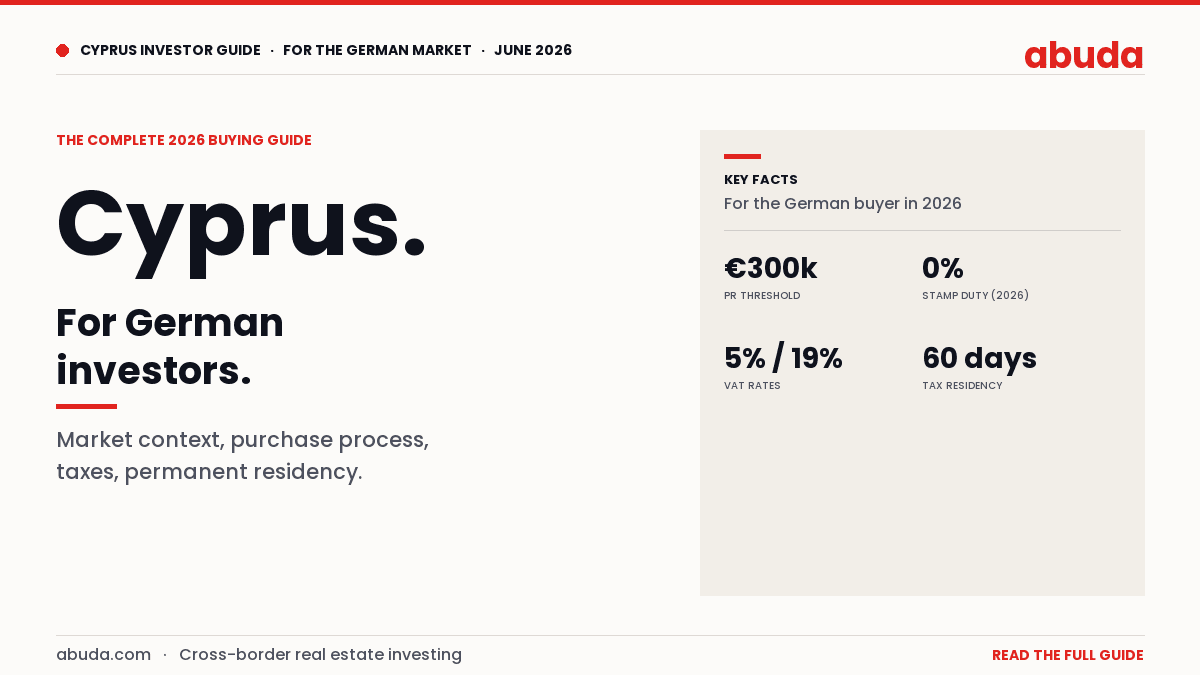
The Cyprus Real Estate Buying Guide for International Investors (German Market Focus)
Published 21 July 2026 by Kefah Abu Gosh
Cyprus has become one of the most consistently attractive residential real estate markets in the European Union — and for German investors and families in particular, the combination of a favourable tax framework, the Germany–Cyprus double taxation agreement, EU legal alignment, and a substantial German-speaking expatriate community makes the island a genuinely serious option rather than an aspirational one.
This guide is written for the German international investor and family buyer. It covers the market context, the property purchase process, the financial considerations, and the questions we hear most often from clients evaluating a Cyprus purchase. It is not a marketing brochure — it is the structured briefing document we hand to buyers before they engage with any specific project on abuda's curated Cyprus pipeline.
TL;DR — The Cyprus Case for German Buyers in 2026
Tax efficiency anchored in the Cyprus non-domicile ("non-dom") regime, the Germany–Cyprus double taxation agreement, and the 2026 Cyprus tax reform package (abolished stamp duty, abolished SDC on rental income, raised CGT exemptions).
A safe, EU-aligned legal environment with transparent title registration and English-language transactional infrastructure.
A meaningful international community including a substantial German-speaking cohort, alongside British, Israeli, Lebanese, Russian, and Ukrainian residents.
Market growth concentrated in Limassol through the technology, online-services, forex, and online-gaming corporate sector — which brings in high-income professional tenants and buyers.
EU-driven construction quality improvements including Energy Class A standards, smart-home integration, and developer incentives for renewable solar photovoltaic systems.
Fast-track permanent residency available through a €300,000+ (plus VAT) new-build property investment.
The rest of this guide unpacks each of these in detail.
1. Executive Summary and Market Context
The Appeal of Cyprus for German Buyers
Cyprus's appeal for the German market rests on four converging pillars.
Tax efficiency. The Cyprus non-domicile regime is the single most consequential tax feature of the Cyprus system for internationally-mobile investors. Individuals who were not tax-resident in Cyprus for the 17 years prior to establishing Cyprus residency can claim non-dom status, which exempts them from the 17% Special Defence Contribution on dividend and passive interest income. For a German investor with dividend-heavy or passive portfolio income, this is a material benefit that compounds meaningfully across a multi-year holding horizon.
Alongside the non-dom regime, the Germany–Cyprus double taxation agreement provides the legal framework preventing income being taxed twice across both jurisdictions. This is the piece of infrastructure that makes moving tax residence to Cyprus — or holding Cyprus property while remaining German tax resident — administratively clean rather than legally hazardous. The 2011 Germany–Cyprus DTA (in force since 2012) covers income taxes, wealth taxes, and inheritance-related matters, and follows the OECD model convention. For a broader look at how Cyprus tax treatment compares to the German-market alternative of holding Berlin residential investment or Frankfurt residential investment, our companion piece — Limassol vs. Larnaca vs. Berlin: Where to Invest in European Real Estate in 2026 — walks through the full comparison.
A safe environment. Cyprus is an EU member state with a common-law-derived legal system, English as the working language of the courts and professions, and a transparent property registration process operated by the Department of Lands and Surveys. For a German buyer accustomed to Rechtssicherheit as a baseline expectation, the Cyprus legal environment provides a comparable — and in some respects more efficient — infrastructure. The specific legal and regulatory risks that historically concerned international buyers — the title deeds issue in particular — have been substantially resolved by the 2025 legal reform, which we cover in detail in What Are the Real Risks of Buying Property in Cyprus in 2026.
International community appeal. Cyprus hosts substantial international resident communities including British, Israeli, Lebanese, Russian, Ukrainian, and increasingly German expatriates. For a German family relocating with school-age children, this matters practically — the international social infrastructure, professional network, and cultural context are meaningfully broader than the island's population size would suggest.
Weather and lifestyle. Cyprus has approximately 320 days of sunshine per year. For a German buyer, the Mediterranean climate is often the initial motivator, but it also translates into a genuinely different quality-of-life proposition — one that many families evaluate as a permanent-residence alternative rather than a holiday-home investment.
Market Drivers — Why Limassol Is Different
The Cyprus property market is not homogeneous. Limassol, in particular, has become structurally distinct from the rest of the island because it hosts the concentrated corporate presence of the international technology, online services, forex, and online-gaming sectors.
These sectors have relocated substantial headquarters and operational teams to Limassol over the past decade — attracted by the Cyprus tax framework, EU regulatory access, and the city's coastal infrastructure. The result is a professional-tenant and buyer pool with materially higher disposable income than would exist in an equivalent-sized Mediterranean coastal city.
The practical implication for a residential investor: Limassol residential values are underpinned by genuine end-user demand from this high-income professional community. Rental defensibility on well-positioned Limassol residential is among the strongest in the Cyprus market, particularly in the neighbourhoods that these professional communities favour — Germasogeia, Agios Athanasios, Agios Tychonas, and the central and coastal Limassol strip. These are the neighbourhoods most represented across the current abuda Limassol pipeline.
For investors evaluating the broader Cyprus market beyond Limassol, Larnaca offers a meaningfully lower entry-price point with potential for capital appreciation, while Paphos supports a distinct lifestyle-oriented investment case anchored in the international retiree and second-home buyer profile.
Construction Quality — EU Compliance and Modern Standards
Cyprus's construction sector has undergone significant modernisation over the past decade, largely driven by EU compliance requirements around energy performance, structural engineering standards, and consumer protection.
Three specific quality dimensions matter for a German buyer:
Energy efficiency. New-build residential in Cyprus increasingly targets Energy Class A certification. This aligns Cyprus residential inventory with the EU energy-performance regulatory framework and delivers materially lower tenant operating costs than older stock. For a buyer accustomed to the German KfW efficiency standards, Cyprus Class A new-build performs comparably. A representative example within the abuda pipeline is Kalamon Ethera in Larnaca, which is delivered to Energy Efficiency Grade A specification.
Modern architectural solutions and smart-home integration. Contemporary Cyprus residential specifications increasingly include underfloor heating, VRV climate systems, floor-to-ceiling glazing, and smart-home integration as standard rather than premium features. This aligns Cyprus inventory with international premium residential expectations. Projects like Kalamon Imperial in Aradippou integrate smart-home operation, underfloor heating, and central cooling as core specifications rather than upgrades.
Renewable energy incentives. Cyprus offers developer incentives — including extra building density permissions — for the installation of renewable energy solutions such as photovoltaic solar systems. The result is that many new-build developments come with integrated solar PV as a default, reducing tenant operating costs and future-proofing the asset against tightening EU energy regulations. For example, Kalamon Noma in central Larnaca is engineered around net-metering photovoltaic infrastructure alongside its Energy Class A certification.
For a German investor, the practical takeaway is that current Cyprus new-build stock meets or exceeds the specification standards typical in the German market, at pricing structurally below German equivalent product. A useful benchmark for that pricing differential is set out in our Q1 2026 Global Investment Matrix, which compares Cyprus and German residential on yield, growth, cost, and tax.
2. The Property Purchase Process — Step-by-Step
The Cyprus property purchase process follows a clear, sequential structure. Understanding it in advance prevents the majority of the friction that international buyers report. Every project you see on abuda follows the same core process — the specifics of pricing, financing, and delivery timing vary by project and are set out in each project's briefing pack.
Step 1 — Reservation Agreement and Deposit
Once you have selected a specific unit within a project, the first formal step is the reservation agreement. This is a short legal document that removes the unit from the developer's market for a defined period (typically 2–4 weeks) while you complete due diligence and prepare to sign the full Contract of Sale.
The reservation is secured by a deposit, typically:
Approximately 5% of the property value, or
A fixed sum around €10,000, depending on the developer's convention.
Two protective conventions apply:
If the buyer withdraws, the deposit is generally forfeited.
If the developer withdraws, the deposit is returned to the buyer, and a contractual penalty (often equal to the deposit itself) is paid.
This structure is standard in the Cyprus market and protects both sides against opportunistic behaviour during the diligence window.
Step 2 — Due Diligence and the Contract of Sale
Before signing the Contract of Sale, you engage an independent Cyprus lawyer to conduct legal due diligence. This is not optional and should never be the lawyer introduced by the developer. Independent legal representation is one of the single most important risk-mitigation steps a buyer takes.
Your lawyer will verify:
The developer's title to the underlying land.
Any prior encumbrances, mortgages, or memoranda on the plot.
The developer's Certificate of Final Approval history and past project delivery record.
The planning permission and approved architectural plans for the project.
The specific unit's compliance with the approved plans.
Upon satisfactory diligence, you sign the Contract of Sale, which typically triggers a payment of 30–35% of the property value.
The Contract of Sale is then deposited with the Land Registry — a critical step. This registration creates a legal "memo" against the property, which prevents the developer from selling the unit to a third party or from placing new encumbrances on it without your consent. This is the mechanism that transforms your position from "buyer who has paid a deposit" to "buyer whose rights are legally protected at the level of the land registry."
For a deeper look at the specific due-diligence checks worth insisting on — and how each maps to a specific historical risk — see our detailed Cyprus property investment risks guide.
Step 3 — Payment Schedule Tied to Construction Milestones
Off-plan Cyprus property is typically paid on a schedule linked to construction milestones. A representative schedule looks like:
Reservation: ~5% (or fixed sum)
Contract of Sale: ~30–35% total paid
Concrete structure completion: ~15–20% additional
Roof / shell completion: ~10–15% additional
Tiling and plastering stage: ~10% additional
Aluminium, doors, and window installation: ~10% additional
Delivery / completion: ~10% final balance
Exact percentages vary by developer, but the principle is that payments are staged against verifiable construction progress. This structure protects the buyer's cashflow exposure — you are not paying for work that has not been done — and creates a natural checkpoint at each milestone. Every project inside the abuda investor portal publishes its specific payment schedule against construction milestones for exactly this reason.
Step 4 — Completion and Government Certification
The final payment is due upon project completion and government certification of compliance with the approved architectural plans. This certification — issued by the local municipality and the Department of Lands and Surveys — confirms that the building has been constructed in accordance with the permitted plans and is fit for occupancy.
At this point, the property is delivered and you take possession.
Step 5 — The Title Deed Timeline
One important expectation to set correctly: the official Title Deed in your personal name typically takes 1–2 years post-completion to be issued. This is a normal administrative delay in the Cyprus system — not a defect.
Historically, this delay was the source of the "trapped buyers" problem that once concerned international investors. That specific issue has been substantially resolved by the 2025 Trapped Buyers Law, passed by the Cyprus House of Representatives on 26 June 2025, which provides a constitutionally-compliant legal route for buyers whose title deed issuance had been delayed by encumbrance disputes. For 2026 buyers of new-build property with a clean project title path, the post-completion title deed timeline is administrative rather than legally risky. Our Cyprus property investment risks guide walks through the 2025 reform in detail.
During the 1–2 year post-completion window, your legal position is protected by:
The registered Contract of Sale in the Land Registry.
Full possession of the property.
The Certificate of Final Approval.
You can occupy, rent, and use the property fully during this window. The Title Deed transfer completes the administrative closure of the transaction.
3. Financial Considerations
Taxes on Purchase
Value Added Tax (VAT). The standard VAT rate on new-build Cyprus property is 19%. However, a reduced 5% VAT rate applies to a primary residence, subject to specific eligibility criteria:
The property must be the buyer's main residence in Cyprus.
Size, value, and use restrictions apply — the reduced rate applies to a defined portion of the property.
The buyer must not own another primary residence in Cyprus.
Important: Misuse of the 5% VAT rate is a serious matter. Declaring a property as a primary residence to obtain the reduced rate and then renting it out triggers government clawbacks — the differential VAT (14%) plus penalties become payable, and the Cyprus Tax Department actively audits this. For an investment property intended for rental use, the 5% rate is not available; the 19% rate applies.
For investors buying rental property, the practical approach is to underwrite the transaction at 19% VAT. For families genuinely relocating to Cyprus who will use the property as their principal residence, the 5% rate is a legitimate and material benefit — but only if the use pattern is genuine.
Stamp Duty. The 2026 Cyprus tax reform, effective 1 January 2026, abolished stamp duty on property contracts. Previously this cost 0.15%–0.20% of the contract value; it is now zero.
Transfer Fees. On resale property (not subject to VAT), transfer fees apply on a graduated scale. On new-build property subject to VAT, transfer fees are typically waived or subject to a 50% discount. Your lawyer will confirm the specific treatment for the transaction.
Taxes During Ownership
Immovable Property Tax. Cyprus abolished the annual Immovable Property Tax in 2017. There is no equivalent to the German Grundsteuer at the national level.
Special Defence Contribution (SDC) on Rental Income. The 2026 Cyprus tax reform abolished SDC on rental income for tax-resident individuals. This lifts net rental yields by approximately 2.25 percentage points versus the pre-reform position — a material improvement to the after-tax investment case.
Income Tax on Rental Income. Standard Cyprus personal income tax rates apply on the taxable portion of rental income (after allowable deductions). Cyprus operates a progressive income tax with a €19,500 personal allowance.
Taxes at Exit
Capital Gains Tax (CGT). Cyprus levies a 20% flat CGT on the profit realised on disposal of Cyprus real estate. Several exemptions reduce the effective liability:
General lifetime exemption: €30,000 per individual (raised in 2026 from €17,086).
Primary residence lifetime exemption: €150,000 per individual (raised in 2026 from €85,430).
Agricultural land exemption: €50,000 (raised in 2026 from €25,629).
These exemptions are one-time lifetime allowances and apply per individual. For a married couple, both spouses' exemptions can typically be used, subject to individual tax positions.
Fees and Transaction Costs
Independent legal fees. Typically ~1% of purchase price. Fixed-fee structures are increasingly common and often more economical for the buyer.
Notarial and registration fees. Modest, typically a few hundred euros.
Total transaction cost on new-build. Post-2026, the total transaction friction on Cyprus new-build purchase is approximately 1.5–2% of purchase price — meaningfully lower than the German equivalent (which typically runs 10–12% including Grunderwerbsteuer, notary, and agent fees). Our three-way European comparison guide sets out this cost differential explicitly for investors weighing Cyprus against Berlin residential positions.
Running Costs
Running costs on Cyprus residential are modest by international comparison:
Communal fees (apartment blocks): typically €50–€200 per month depending on the amenity profile (pool, gym, wellness spa, concierge, etc.).
Municipal taxes: approximately €175 per unit per year.
Refuse collection and sewerage charges: typically €100–€300 combined per year depending on locality.
Electricity, water: metered utilities, paid based on actual use.
Property management (for non-resident landlords): typically 10–15% of gross rent for full-service management.
For an investment underwriting model, budgeting €1,500–€3,000 per year of all-in operating costs on a mid-market apartment (excluding utilities that tenants typically pay) is a reasonable starting point.
4. Frequently Asked Questions
Can I resell a property during construction ("flipping")?
Yes. Cyprus permits the resale of a property held under a Contract of Sale before Title Deed issuance and before physical completion. This is executed via an assignment of the Contract of Sale to the new buyer, typically with the developer's consent. This flexibility gives investors an early-cycle exit option on projects that have appreciated during the construction window. Our current Cyprus off-plan pipeline includes several projects positioned specifically for this kind of appreciation capture.
Is Cyprus part of the Schengen Area?
Not yet. Cyprus has met the technical requirements for Schengen accession and the European Commission has confirmed compliance. However, the political decision has been delayed due to complexities around the Northern border (the Turkish-occupied area of the island). For international travellers, this means Cyprus visa policy currently operates independently of Schengen — practically, the main implication is that a Schengen visa is not automatically valid for Cyprus, and vice versa.
Once accession completes, the practical convenience for German residents already comfortable moving within Schengen will increase further, and property holders in Cyprus should benefit from smoother travel between Cyprus and the German mainland.
What are the residency options for German buyers?
Three main structures matter:
Cyprus Permanent Residency (fast-track). Available through a new-build residential property investment of €300,000 (plus VAT) or more. The programme is fast-track — decisions are typically issued within 2 months of application, with routine renewal procedures thereafter. Projects at or above this threshold across the Cyprus abuda pipeline — including several in Larnaca and Paphos — support the PR application.
Cyprus tax residency ("60-day" or "183-day" rule). Physical presence-based residency triggering the Cyprus tax regime. Under the 60-day rule, an individual can establish Cyprus tax residency by spending at least 60 days in Cyprus, meeting a set of qualifying conditions (no other tax residency, employment/business/directorship in Cyprus, maintenance of a permanent home in Cyprus). This is particularly relevant for internationally-mobile German professionals.
Non-domicile status. Applied for once Cyprus tax residency is established, subject to the 17-year prior non-residence test. Delivers the 17% SDC exemption on dividend and passive interest income.
The three can be combined — many German buyers acquire a Cyprus property, establish Cyprus tax residency under the 60-day rule, and register as non-doms, all within a coherent tax-optimisation structure. Coordination with both a German tax advisor and a Cyprus tax advisor is essential.
When is the best time to conduct site visits?
Avoid August. The country effectively shuts down for the summer holiday period — government offices, banks, notaries, and many businesses become inaccessible or run at minimum capacity. This is not a market to attempt due diligence, contract signing, or Land Registry work in during peak summer.
Best months for site visits: April, May, September, October. Weather is comfortable, the professional infrastructure is operating normally, and daylight is generous.
Second-best: November through March. Cooler weather but sunny days remain common, and property professionals are attentive and available.
If you are planning site visits across multiple projects, the abuda team can coordinate a structured multi-project visit through the projects overview page — this is typically the most efficient way for an international buyer to evaluate three to five projects across Limassol, Larnaca, and Paphos within a single 3–4 day visit.
How does the cost of living compare to Germany?
Cyprus's overall cost of living is slightly cheaper than Germany's, though the differential varies by lifestyle and location. Specific comparisons:
Groceries and everyday goods: modestly cheaper than Germany, though imported items can be comparable or slightly more expensive.
Dining out: meaningfully cheaper for equivalent restaurant tiers.
Utilities: electricity is expensive by EU standards (heavy air-conditioning use in summer months matters); heating costs are lower given the mild winters.
Petrol / fuel: cheaper than Germany.
Private healthcare: meaningfully cheaper for equivalent quality.
International schooling: generally cheaper than international schooling in major German cities, with high-quality options in Limassol, Paphos, and Nicosia.
For a German family relocating, the practical difference is often not the absolute cost level but the quality of life at equivalent spend — the same €4,000–€5,000 per month budget supports a materially different lifestyle in Cyprus than in Munich or Frankfurt.
Are schools and healthcare accessible for German families?
Yes. International schools in Cyprus — particularly in Limassol and Paphos — are well-established, offering British, American, French, Russian, and IB curricula. The German-speaking community in Limassol supports informal German-language educational and cultural infrastructure alongside the primary international schools.
Healthcare in Cyprus is delivered through both the General Health System (GHS/GESY) — the Cyprus universal healthcare system — and a substantial private healthcare sector with modern hospitals and clinics, particularly in Limassol and Nicosia. Many practitioners speak English fluently; German-speaking practitioners are available, particularly in Limassol.
For families with school-age children, the practical educational and healthcare infrastructure available in Limassol is comparable to what would be available in a mid-sized German city.
Do I need to be physically present in Cyprus to complete a purchase?
Not necessarily. Many international buyers execute the entire purchase remotely through a Power of Attorney granted to their Cyprus lawyer, who then acts on their behalf for contract signing, Land Registry registration, and completion. Site visits before signing are strongly recommended, but administrative completion can be conducted remotely once the purchase decision is made.
What ongoing German tax implications apply after purchase?
If you remain German tax resident, rental income from Cyprus property is generally taxable in Germany, subject to the provisions of the Germany–Cyprus double taxation agreement. The DTA typically provides either an exemption or a credit mechanism to prevent double taxation. Coordination with a German tax advisor is essential to structure the ownership optimally — including consideration of whether to hold the property individually, through a German entity, or through a Cyprus entity.
If you become Cyprus tax resident, the tax framework shifts substantially — the non-dom regime becomes accessible, Cyprus-source income is taxed under the Cyprus system, and the German tax exposure reduces to any remaining German-source income and assets.
Next Steps
If you are a German investor or family evaluating a Cyprus property purchase in 2026, three practical next steps:
Browse the abuda curated pipeline — Limassol, Larnaca, and Paphos — to see the current available inventory across our four Cyprus cities.
Explore our platform's cross-border approach and browse past client references to see how we work with international investors.
Book an introductory call with the abuda team at hello@abuda.com for a personalised briefing based on your objectives (permanent residency, yield, family relocation, or blended).
Coordinate early with both a German tax advisor and a Cyprus tax advisor — the earlier the two work in parallel, the cleaner the transaction structure.
For the broader European context on how Cyprus fits alongside Berlin as the two most consistent long-hold real estate positions on our platform, see our companion guide: Limassol vs. Larnaca vs. Berlin — Where to Invest in European Real Estate in 2026.
For a deeper look at the specific legal and regulatory risks of Cyprus property investment — and how they have shifted in the 2026 landscape — see What Are the Real Risks of Buying Property in Cyprus in 2026.
This guide is informational and does not constitute financial, tax, or legal advice. Tax outcomes depend on individual circumstances and should always be confirmed with qualified tax advisors in both jurisdictions. Property markets and regulatory frameworks change; abuda updates this guide quarterly.