Cyprus Property Reservation Agreement Explained: What Developers' Reservation Forms Actually Say — Fees, Refunds, Deadlines and a Review Checklist (Based on Real Contracts)
Important notice. This article is general information based on a limited sample of anonymised developer documents and on the law and practice of Cyprus as understood by the author at October 2026. It is not legal, tax or financial advice, it does not create an adviser–client relationship, and it mus
Published 26 October 2026 by Kefah Abu Gosh
Important notice. This article is general information based on a limited sample of anonymised developer documents and on the law and practice of Cyprus as understood by the author at October 2026. It is not legal, tax or financial advice, it does not create an adviser–client relationship, and it must not be relied on as a substitute for advice from an independent Cyprus advocate on your own documents and circumstances. Figures described as "typical", "standard" or "good practice" are observations from the sample and the author's opinion, not guarantees of what any developer will offer or what a court would decide. Laws, regulations and market practice change; verify before acting. abuda and the author accept no liability for any loss arising from reliance on this content.
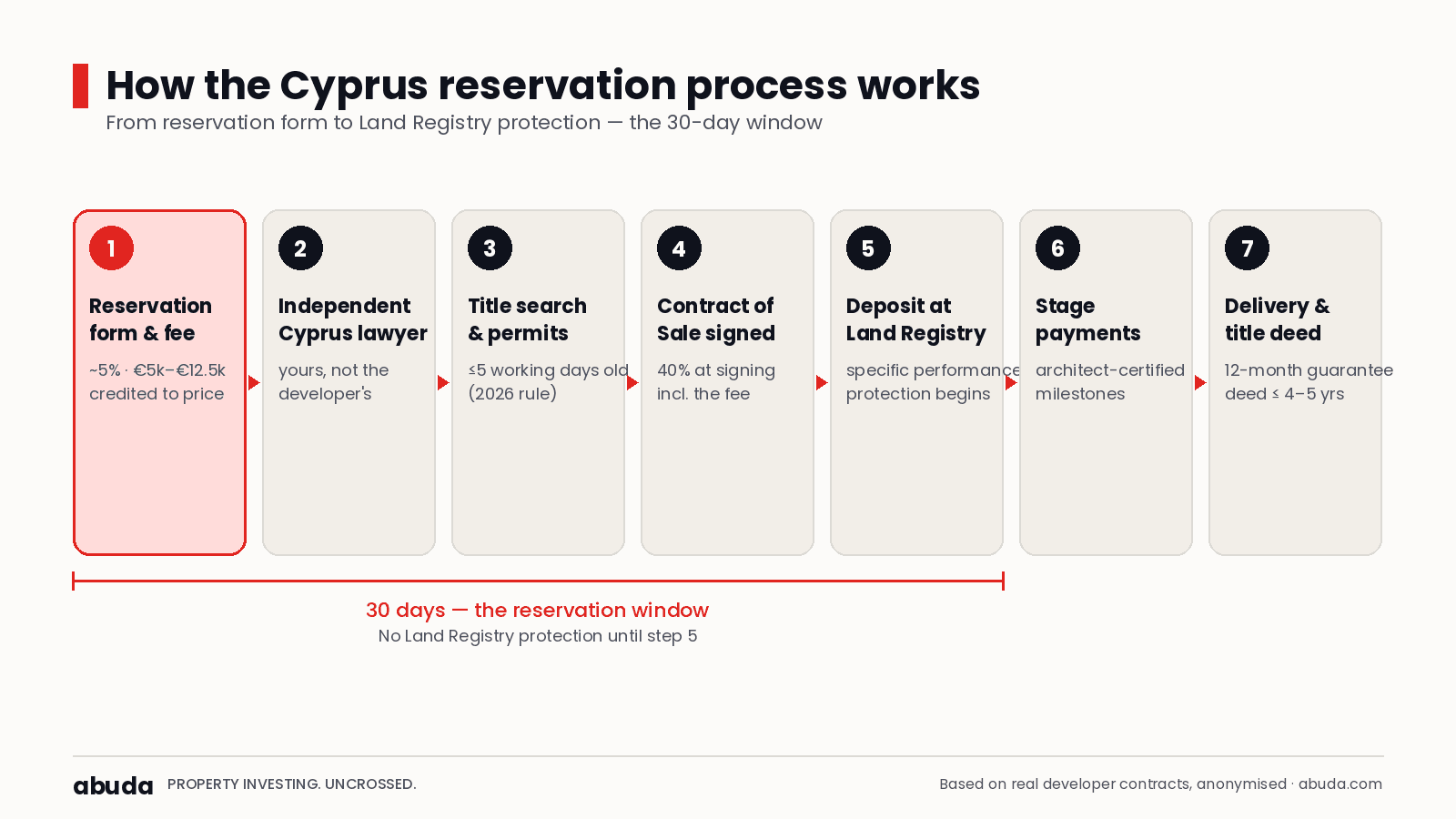
TL;DR — A Cyprus property reservation agreement is the short, binding document you sign with a developer to take a specific new-build unit off the market while the Contract of Sale is prepared. Based on the actual reservation agreements and contracts of sale that pass through abuda — a sample of Larnaca-district developer documents dated 2019 to 2026, anonymised for this article — the pattern is consistent: a reservation fee of €5,000–€12,500 (most often 5% of the price, range roughly 2–6%), credited against the purchase price; a 30-day window to sign the Contract of Sale; the fee non-refundable if the buyer walks away, refundable in full (typically within 10 business days) if the developer cannot proceed or is in breach; an exclusivity undertaking by the developer; a preview of the payment plan; and an estimated delivery date with a grace period and a monthly delay penalty (€800–€900/month in the samples). What a reservation does not give you is any protection at the Land Registry — that only begins when the Contract of Sale is deposited. This guide explains every clause, the numbers to expect, the mistakes we have found in real forms, and a checklist you (or ChatGPT, Claude or any AI assistant you paste your form into) can run before you pay.
Key facts at a glance — what a Cyprus developer reservation form normally contains
| Element | What the sample documents show | What to check (author's view — confirm with your advocate) |
|---|---|---|
| Reservation fee | €5,000 · €8,500 · €10,000 · €10,000 · €12,500 — i.e. ~1.8%, 5%, 5.9%, 3.9%, 5% of price; 5% is the mode | Is it stated "+ VAT" or "including VAT"? Is it credited to the price in full? |
| Validity | Reservation valid only once the full fee is received in the developer's account | Pay by traceable bank transfer; get a receipt |
| Deadline to sign Contract of Sale | 30 days from the reservation date | Is there a consequence if the developer misses it? |
| Refundability | Non-refundable, except on developer breach or inability to sell → full refund within 10 business days | Add: refundable if your lawyer's due diligence fails or the Contract terms cannot be agreed |
| Exclusivity | Developer will not sell, reserve or negotiate the unit with anyone else during the validity period | Make sure it is in writing |
| Property identification | Unit number, block, floor, bedrooms, parking bay number, storage number | Must match the plans and the later Contract exactly |
| Price | Stated "+ VAT" (19%, or 5% on a qualifying primary residence) | Confirm whether the price includes parking, storage, appliances |
| Inclusions / allowance | Some forms list appliances, air-conditioning and furniture "subject to a total allowance of €10,000" | Allowance = a budget, not the items; anything above is extra |
| Delivery | "30 months from commencement of construction, subject to a grace period", with a backstop date for commencement | Insist on a backstop date for delivery, not just for commencement |
| Delay compensation | €800 per month (pro rata) after the grace period | Carry it into the Contract of Sale unchanged |
| Payment plan preview | 35–40% at Contract (including the fee), then stage payments against construction, 0.5–10% at delivery | Check that the instalments add up to the price |
| Encumbrances | Developer will transfer free of mortgages, memos, charges, liens, with vacant possession | Must be repeated — and proven — in the Contract |
| Governing law | Laws of the Republic of Cyprus; exclusive jurisdiction of Cyprus courts | Standard |
| Land Registry protection | None — a reservation is not deposited | Protection starts only when the Contract of Sale is lodged |
About the documents this guide is based on
This is not a theoretical explainer. abuda works with developers across Larnaca, Limassol, Paphos and Nicosia, and the documents buyers send us for review are the raw material for this article: a signed 2026 reservation agreement for a two-bedroom apartment in a Larnaca-district project; the reservation clauses embedded in five contracts of sale for apartments and houses dated 2026 from three different developer templates; and, for contrast, a short-form sale agreement bundle from 2019 together with the stamp-duty receipt, company certificates and title deed that were deposited with it at the Land Registry. Every name, company, registration number, plot reference, address and price list has been removed; the clauses, numbers, timelines and drafting errors are real. Where we quote a figure, it is a figure that appeared in one of these documents.
What is a reservation agreement in Cyprus, legally?
A reservation agreement (sometimes "reservation form", "booking form" or "letter of intent") is a binding pre-contract between the developer (the "Vendor") and you (the "Purchaser"). In exchange for a reservation fee, the developer agrees to hold a specific unit at an agreed price for a fixed period while the full Contract of Sale is drafted, reviewed and signed. It is governed by Cyprus contract law and the parties expressly reserve their rights under it — the samples state that it "binds the Parties, their legal agents, directors, proxies, employees, representatives and heirs."
Three things it is not:
- It is not the Contract of Sale. It fixes the unit, the price and the headline terms; the 8–10-page Contract of Sale that follows fixes everything else — specifications, milestones, defects, title transfer, termination. Our companion article explains that document clause by clause: Cyprus contract of sale explained.
- It is not deposited at the Land Registry. Under the Sale of Immovable Property (Specific Performance) Law, only a Contract of Sale can be lodged with the District Lands Office, and only a lodged contract gives you the right of specific performance — the right to have the court compel transfer of the unit to you. A reservation gives you a contractual claim against the developer, not a claim on the land.
- It is not proof of title, permits or an unmortgaged plot. The reservation form in our sample says the developer "will transfer the Property free from any mortgages, memos, charges, liens"; it does not prove that. That is what your lawyer's due diligence, and the search certificate attached to the Contract of Sale, are for.
Anatomy of a real Cyprus reservation agreement, clause by clause
1. The parties
The developer company (registration number, registered address, authorised signatory) and you (full name, passport or ID number, contact details). Check that the company named is the one that will sign the Contract of Sale and that holds — or has a registered right to — the land. In Larnaca it is common for a project to be built under a land-exchange agreement (Συμφωνία Αντιπαροχής): the developer builds on land owned by someone else in exchange for a share of the units. One of the sample contracts recites exactly this. It is a legitimate structure, but it means the developer is not the registered owner, and your lawyer must confirm that the exchange agreement is itself deposited at the Land Registry and that the landowner's consent covers your unit.
2. Identification of the property
Unit number, block, floor, number of bedrooms, and — critically — the parking space number and storage room number. In the sample form these are written out in the pattern "two-bedroom apartment [number] in Block [letter] … together with parking space No. P[number] and storage room No. S[number]". Parking and storage are frequently sold separately in Cyprus; if they are not in the reservation, assume they are not included in the price.
3. The reservation fee and its treatment
The form states the amount, that it is payable on signing, that it "shall form part of and be credited towards the Purchase Price", and that the reservation is only valid once the full amount is received. Observed amounts: €5,000 on a townhouse priced around €280,000 (1.8%); €8,500 on a €170,000 apartment (5%); €10,000 on a €169,000 apartment (5.9%); €10,000 on a €255,000 apartment (3.9%); €12,500 on a €250,000 apartment (5%). Five per cent is the Larnaca norm; houses and townhouses sometimes take a flat €5,000.
One detail to read twice: whether the fee is "including VAT" or "plus VAT". The sample reservation form says the €10,000 is "including VAT", while every later instalment is "plus VAT". That is fine as long as the Contract of Sale credits the fee correctly against the VAT-inclusive total; ask your lawyer to check the credit line in clause 3(a) of the Contract.
4. Inclusions and the "allowance" clause
Some developers use the reservation form to list what the price includes — kitchen appliances, air-conditioning units by BTU and brand "or equivalent", a furniture pack, outdoor furniture — "subject to a total allowance of €X". An allowance is a budget, not a promise of specific items: if the listed items cost more than the allowance, you pay the difference; if you decline them, you may or may not receive a credit. Have the allowance, the item list and the credit rule repeated in the Contract of Sale's specification appendix.
5. The deadline to sign the Contract of Sale
"The Parties shall execute the Contract of Sale within thirty (30) days from the date of signing this Reservation Agreement." Thirty days is the period we see most often and is usually enough for a Cyprus advocate to run a due-diligence file. Two points to negotiate: an automatic extension if the developer has not delivered the draft Contract and appendices within, say, 10 days; and clarity that if the 30 days lapse because of the developer, the fee is refunded.
6. Refundability
The standard wording: "The Reservation Fee shall be non-refundable, save in the event of a breach or failure attributable to the Vendors or where the Vendors are unable to proceed with the sale of the Property, in which case the Reservation Fee shall be refunded in full to the Purchaser within ten (10) business days."
That protects you if the developer cannot sell (for example the unit is already reserved, the landowner withholds consent, the permit is refused). It does not protect you if your lawyer finds a problem — a mortgage on the land, a missing planning permit, an unacceptable Contract clause — and you decide not to proceed. Three refund triggers are worth adding before you pay:
- Due-diligence condition: refundable in full if the Purchaser's lawyer, acting reasonably, is not satisfied with title, encumbrances, permits or the land-exchange position within the 30 days.
- Contract-terms condition: refundable if the Parties, negotiating in good faith, cannot agree the Contract of Sale within the period.
- Permit condition: refundable if the planning permit (or, for a project not yet permitted, the building permit) is not issued by an agreed date.
These are negotiating points, not entitlements; whether a developer accepts them is a commercial matter, and your advocate is the right person to put them forward.
7. Exclusivity
"During the validity of this Agreement, the Vendors undertake not to sell, reserve or otherwise negotiate the sale of the Property with any third party, unless the Purchaser is in breach." This is the practical value of the fee: the unit is yours while you do your homework. Confirm the validity period is at least as long as the Contract deadline plus any extension.
8. Delivery date, grace period and delay compensation
The sample form defines delivery as "30 months from the commencement of construction, subject to a grace period of two (3) months" — yes, the form says "two (3)", a drafting slip that should be corrected before signing — and adds "Commencement of construction shall be no later than [date]." Then: "In the event that the Vendors fail to complete and deliver the Property within the aforesaid grace period, the Vendors shall pay … €800 for each month of delay, calculated pro rata."
Three lessons. First, tie delivery to a calendar backstop ("no later than [date]"), not only to "commencement", or you inherit every slip in the start date. Second, insist that the same delay compensation and the same grace period are carried into the Contract of Sale — in the sample contracts the figures were €800–€900 per month after 30 days to 3 months of grace, and one template had no delay penalty at all. Third, confirm what happens if the delay runs long: the better contracts let the buyer terminate with a full refund after 12 months' delay.
9. The payment plan preview
Most reservation forms set out the stage payments that the Contract of Sale will formalise. The sample form shows a schedule of €10,000 reservation → 35% at Contract (including the reservation) → six instalments of 10% at excavation, first slab, second slab, frame, brickwork of the specific apartment, tiling of the specific apartment → 4.5% at delivery → 0.5% at issue of the Certificate of Final Approval. The contracts of sale in our sample use a shorter ladder — typically 40% at Contract (including the fee) → 20% at concrete frame → 15% at brickwork and plaster → 15% at tiles, windows and doors → 10% at delivery for apartments, and 40% → 30% at frame → 15% at masonry → 10% at floors → 5% at delivery for houses. The pattern that matters: front-loaded, milestone-based, with a meaningful amount held back until delivery — and, in the best forms, a final sliver held until the Certificate of Final Approval, which is the document that unlocks separate title deeds.
Check the arithmetic. In the sample reservation form, the instalments as written added up to a total about €5,000 higher than the purchase price stated on page one — a typo in either the price or the 35% figure that would have been carried straight into the Contract of Sale had nobody added the column. Add the column. Then check that the percentages match the euro amounts, and that the fee is shown as included in the first instalment, not in addition to it (one of the sample contracts was ambiguous on exactly this point).
10. Bank details, contacts, governing law, signatures
The developer's account for the fee (pay only to the company named in the agreement, never to an individual or an agent); contact details for both sides; "governed by the laws of the Republic of Cyprus … exclusive jurisdiction of the Courts of the Republic of Cyprus"; signatures of the authorised representative and the purchaser. Ask for the company's certificate of directors or a board resolution if the signatory is not a registered director — the 2019 bundle in our sample shows exactly those certificates being filed alongside the agreement.
The reservation timeline: what happens in the 30 days
| Day | Step | Who |
|---|---|---|
| 0 | Sign the reservation agreement; transfer the fee; receive receipt | You · developer |
| 0–3 | Appoint an independent Cyprus lawyer (yours, not the developer's); grant power of attorney if buying remotely | You |
| 1–7 | Developer's bank runs KYC / source-of-funds checks on you — the newer contracts make your cooperation an express obligation and exclude bank delays from "late payment" | You · developer's bank |
| 1–14 | Lawyer obtains the title deed and a fresh Land Registry search certificate (the 2026 rules require one dated within five working days of signing the Contract), the planning permit (and building permit if issued), the architectural plans and specifications, the land-exchange agreement if any, and the developer's company certificates | Your lawyer |
| 7–21 | Developer issues the draft Contract of Sale with Appendices A–E; lawyer marks it up (see the clause-by-clause guide) | Developer · your lawyer |
| 14–28 | If you intend to apply for the reduced 5% VAT as a primary residence, prepare the application; one sample contract explains that it can only be filed after the planning permit is issued and that you pay 19% until approval, with the difference credited or refunded within 14 days | You · lawyer · VAT office |
| ≤30 | Sign the Contract of Sale; pay the first instalment (the fee is credited); contract is deposited at the Land Registry — the moment your specific-performance protection begins | All |
What a reservation does not protect you from
- A mortgaged plot. Until the Contract of Sale is deposited with the search certificate and, where the land is charged, the bank's written undertaking to release your unit at 95% payment, you have no protection against the developer's lender.
- A unit sold twice. Only a deposited Contract of Sale prevents a later contract on the same unit from being lodged.
- Developer insolvency. A reservation is an unsecured claim.
- Permit risk. Several sample contracts say the sale is "subject to the Vendor obtaining the building permit." If the project is at planning-permit stage only, ask what happens to your money if the building permit is refused or delayed; the better template gives the buyer a full refund if the building permit has not issued by the time construction is complete.
- Specification drift. The reservation names the unit; the specification appendix of the Contract defines what you get. Allowance-based specifications ("tiles worth €20 per m²") are common — see the companion article.
Red flags in a reservation form
- The fee is payable to an individual, an agent or an account in a different company name.
- No deadline for the developer to produce the Contract of Sale.
- "Non-refundable" with no developer-fault exception.
- Delivery defined only from "commencement of construction" with no backstop date.
- No parking or storage numbers, or parking "to be allocated".
- Instalments that do not add up to the price, or percentages that do not match the euro figures.
- A signatory who is not a registered director and no power of attorney attached.
- Pressure to sign the Contract of Sale in days rather than weeks, or to skip the lawyer.
The 15-point reservation checklist — run it yourself or with an AI assistant
Paste your reservation form into ChatGPT, Claude or Gemini and ask it to answer each point from the text; then confirm the answers with a Cyprus lawyer.
- Is the developer named exactly as the registered company that holds the land or the land-exchange right?
- Is the unit identified by number, block, floor, bedrooms, parking number and storage number?
- What is the reservation fee, is it "+ VAT" or "including VAT", and is it expressly credited to the price?
- Is the reservation valid only on receipt of funds, and is a receipt promised?
- How many days to sign the Contract of Sale, and what happens if the developer misses the deadline?
- In which circumstances is the fee refunded, within how many days, and does that include failed due diligence?
- Does the developer undertake exclusivity for the whole period?
- Is the price stated with VAT treatment, and what does it include (appliances, furniture, allowance amount)?
- Is delivery defined with a calendar backstop, what is the grace period, and is the grace period written consistently?
- What is the monthly delay compensation, and is there a long-stop right to terminate with refund?
- Do the payment-plan instalments add up to the purchase price, and is the fee shown as part of the first instalment?
- Is any amount held back until delivery, and any until the Certificate of Final Approval?
- Does the developer undertake to transfer free of mortgages, charges and liens with vacant possession?
- Is the bank account in the developer company's name?
- Is the agreement governed by Cyprus law with Cyprus jurisdiction, and signed by an authorised person?
How reservations work through abuda
Every project on abuda shows availability by unit as supplied by the developer, and pricing opens on the project page after registration. When you reserve through the platform, the reservation agreement is the developer's own document: abuda does not draft, replace, verify or advise on it, and the terms you sign are a matter between you, the developer and your own advocate. abuda is a marketing and listing platform, not a law firm, and nothing on the platform is legal advice. The next step in every case is the Contract of Sale, explained in Cyprus contract of sale explained clause by clause. For the whole journey from reservation to title deed, see the Cyprus Buying Guide and the diligence checklist in Cyprus property risks 2026. Browse current pre-sale releases by city: Larnaca · Limassol · Paphos · Berlin.
Questions about a project on abuda
If your question concerns a project listed on abuda — availability, the unit, the published payment plan or how to register — write to hello@abuda.com or WhatsApp +49 172 983 1161. We can share the general information in this article and, if you ask, names of independent Cyprus advocates; the choice of adviser, the engagement and the advice are yours and theirs. We do not review, interpret or give opinions on individual reservation agreements or contracts, and nothing we send is legal advice. Have every document reviewed by an independent Cyprus advocate before you sign or pay.
Frequently asked questions
Q. What is a reservation agreement when buying property in Cyprus? A. A short, binding pre-contract with the developer that takes a specific unit off the market at an agreed price, in exchange for a reservation fee, for a fixed period (typically 30 days) while the full Contract of Sale is prepared and signed.
Q. How much is the reservation fee for a new-build property in Cyprus? A. In the developer documents reviewed for this article, €5,000–€12,500 — most often 5% of the purchase price, with a range of roughly 2–6%. The fee is credited against the price.
Q. Is a reservation fee refundable in Cyprus? A. Usually not if the buyer withdraws, but refundable in full — typically within 10 business days — if the developer is in breach or cannot proceed with the sale. Buyers should add a refund right if their lawyer's due diligence fails or the Contract of Sale cannot be agreed.
Q. How long do I have to sign the Contract of Sale after reserving? A. Thirty days is the standard period in the sample agreements.
Q. Does a reservation agreement protect me at the Land Registry? A. No. Only a deposited Contract of Sale gives specific-performance protection under Cyprus law. A reservation is a contractual claim against the developer only.
Q. What should the reservation form say about delivery? A. A delivery period with a calendar backstop, a defined grace period, a monthly delay penalty (€800–€900 per month in the samples) and, ideally, a right to terminate with a full refund if the delay exceeds 12 months — all to be repeated in the Contract of Sale.
Q. Can I reserve a property in Cyprus remotely from abroad? A. Yes. The reservation is signed electronically or by courier and the fee is paid by bank transfer; the Contract of Sale can be signed and deposited by a Cyprus lawyer holding your power of attorney.
Q. What is the difference between a reservation fee and a deposit in Cyprus? A. In practice the reservation fee is the first deposit: the contracts of sale in our sample describe the amount "already paid as a reservation fee, hereinafter referred to as the Deposit", and credit it against the first instalment due at signing.
Glossary
- Reservation agreement / form — binding pre-contract holding a unit for a fixed period against a fee.
- Contract of Sale (CoS) / Sale Agreement — the full purchase contract, deposited at the Land Registry.
- Specific performance — the court-ordered transfer of the property to the buyer, available only for a deposited Contract of Sale under the Sale of Immovable Property (Specific Performance) Law.
- Search certificate — Land Registry extract showing registered owner, mortgages and encumbrances; required within five working days of signing under the 2026 rules.
- Land-exchange agreement (Αντιπαροχή) — arrangement under which a developer builds on a landowner's plot in return for a share of the units.
- Certificate of Final Approval — the planning authority's completion certificate under the Streets and Buildings Regulation Law, Cap. 96; the gateway to separate title deeds.
- Allowance / PC sum — a budgeted amount for an item or category in the specification; costs above it are extras.
- Grace period — the extra time after the delivery date before delay compensation starts.