Cyprus Contract of Sale Explained Clause by Clause: How Developers' Purchase Agreements for New-Build Property Actually Work — Payment Schedules, Delivery, Penalties, Title Deeds and a 25-Point Review Checklist (Based on Real Contracts)
Important notice. This article is general information based on a limited sample of anonymised developer documents and on the law and practice of Cyprus as understood by the author at October 2026. It is not legal, tax or financial advice, it does not create an adviser–client relationship, and it mus
Published 27 October 2026 by Kefah Abu Gosh
Important notice. This article is general information based on a limited sample of anonymised developer documents and on the law and practice of Cyprus as understood by the author at October 2026. It is not legal, tax or financial advice, it does not create an adviser–client relationship, and it must not be relied on as a substitute for advice from an independent Cyprus advocate on your own contract and circumstances. Figures described as "typical", "market norm" or "good practice" are observations from the sample and the author's opinion, not guarantees of what any developer will offer or what a court would decide. Summaries of legislation are for orientation only; the current text of each law prevails. Laws, regulations and market practice change; verify before acting. abuda and the author accept no liability for any loss arising from reliance on this content.
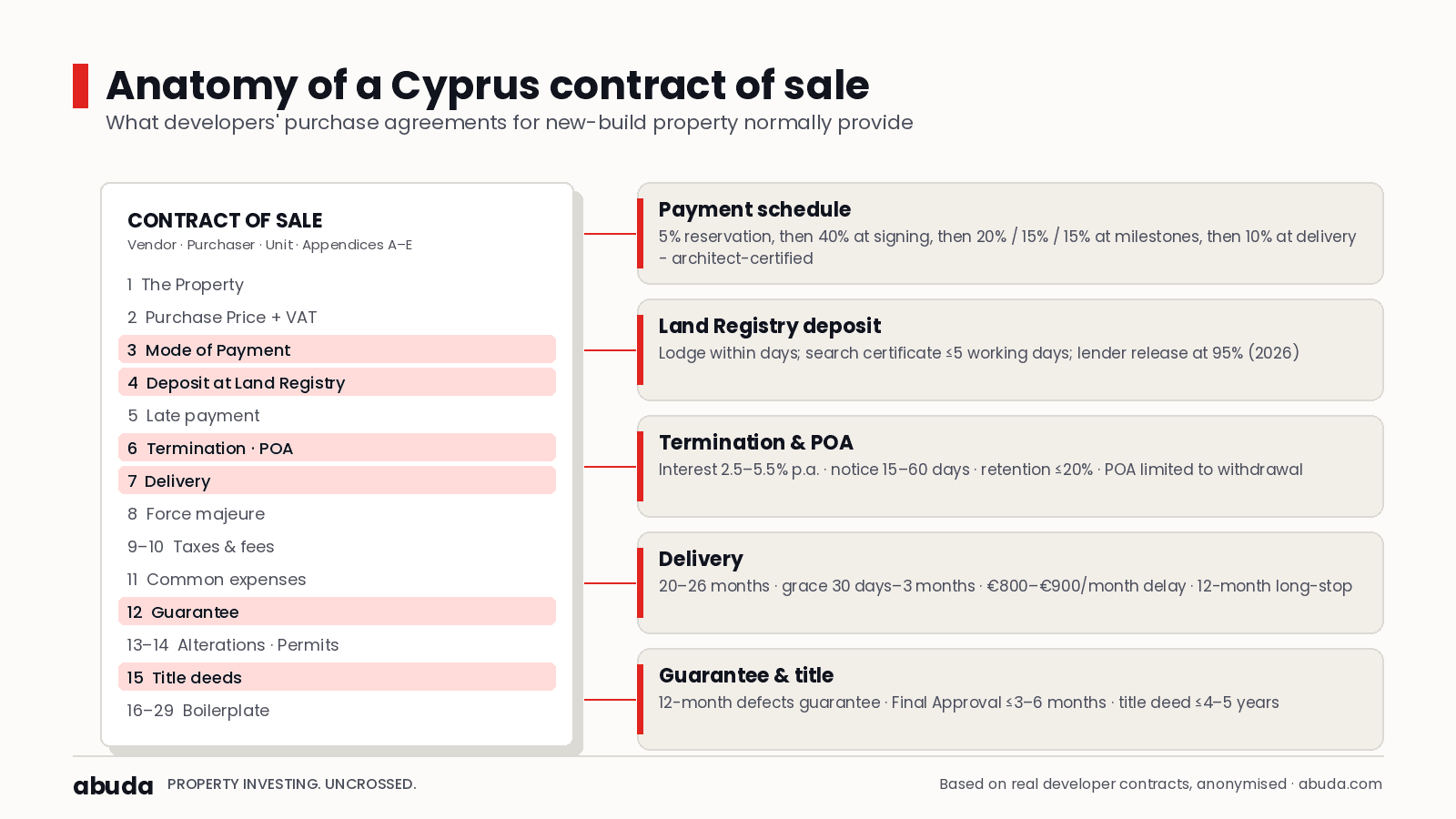
TL;DR — The Cyprus contract of sale (often titled "Contract of Sale" or "Sales Agreement") is the 8–10-page document that turns a reservation into a legally enforceable purchase of a new-build apartment or house from a developer. This guide is built from real developer contracts that buyers brought to abuda — five 2026 contracts from three different developer templates covering apartments, townhouses and detached houses in the Larnaca district, plus a short-form 2019 sale agreement with its Land Registry deposit bundle — with every identifying detail removed. Across the templates the architecture is the same, and the numbers cluster: the reservation fee becomes the "Deposit"; 40% is paid at signing (including the fee); stage payments follow certified construction milestones; 5–10% is held until delivery. The contract is deposited at the District Lands Office — the step that gives you specific-performance protection — either on signing or when the first instalment clears. Late payment attracts 2.5–5.5% interest and, after a grace period, a termination right under which the developer keeps up to 20% of the price as agreed damages. Delivery is promised in 20–26 months (or by a fixed date) with 30 days to 3 months' grace and €800–€900 per month of delay compensation — in one template, none. A 12-month defects guarantee, a 3% area tolerance, a Certificate of Final Approval application within 3–6 months of completion and separate title deeds "within 4–5 years" complete the picture. Two clauses deserve special attention: the irrevocable power of attorney that lets the developer withdraw your contract from the Land Registry if you default, and the breadth of force majeure. Below: every clause, what the samples say, what the 2026 law requires, what to negotiate, and a checklist you — or ChatGPT, Claude or Gemini with your contract pasted in — can run.
Benchmark values at a glance — what Cyprus developer contracts of sale normally provide
| Clause | Range observed in the sample contracts (2019–2026) | Good practice in the author's view — points to raise with your advocate |
|---|---|---|
| Reservation fee → "Deposit" | €5,000–€12,500; 2–6% of price; credited to first instalment | 5%; confirm it is within the first instalment |
| Paid at signing (cumulative incl. fee) | 25–40% | 30–40%; never more than 40% before the contract is deposited |
| Stage payments | Apartments: 20% frame · 15% brickwork & plaster · 15% tiles, windows & doors · 10% delivery. Houses: 30% frame · 15% masonry · 10% floors · 5% delivery. Townhouse: ~18% frame · ~18% walls · ~18% plaster & M&E · ~16% finishes · ~3.5% delivery | Each stage certified in writing by the supervising architect/engineer; 10 days' notice + invoice before payment is due |
| Hold-back at delivery | 3.5–10% | ≥10%, conditional on snagging list being cleared; a further 0.5–3% until the Certificate of Final Approval is the best practice seen |
| Payment grace / "late" | 9–15 working days | ≥10 working days; bank/KYC delays expressly excluded |
| Late-payment interest | 2.5% · 5% · 5.5% per annum | ≤5% p.a. |
| Developer termination for non-payment | After 10–14 days' default + 15–60 days' written notice | ≥30 days' notice with a cure period |
| Developer's retention on buyer default | Up to 20% of the price as "agreed damages", balance refunded within 30 days or on withdrawal of the contract from the Land Registry; one template refunds everything but reserves a damages claim | ≤10–20%; refund timetable in days, not "upon withdrawal" |
| Deposit of contract at Land Registry | On payment of the first instalment (apartments) · after the reservation fee clears (townhouse) · buyer's right (house) | Within days of signing — the law allows six months but every day un-lodged is unprotected |
| Delivery period | 20 months · 26 months from signing · 30 months from commencement · fixed calendar date · 14 months from building permit (2019) | Calendar backstop + grace ≤ 3 months |
| Delay compensation | €900/month after 30 days' grace · €800/month after 2 months' grace · none | ≥ market rent of the unit per month; long-stop termination with full refund after 12 months' delay (present in the best template, refund within 10 days) |
| Definition of delivery | Electricity from EAC, water, roads, pavements, full access; architect's certificate; buyer signs delivery form; deemed delivered if not signed within 1 month | Add: snagging list cleared "to reasonable satisfaction" before final payment |
| Force majeure | Act of God, war, strikes, government interference, lockdowns, capital controls, "lack of building materials", utility-authority delays, subcontractor breach | Narrow it; require architect certification of time lost; mutual termination after 12 months |
| Defects guarantee | 12 months from delivery for workmanship/materials; structural "as regulated by law" | 12 months minimum; written snagging procedure; architect's certificate as trigger |
| Area tolerance | ±3% of unit area, ±5% of plot; price reduced pro rata if >3% smaller (newer template) | Price adjustment both ways above 3% |
| Alterations | Buyer changes allowed within 5 months of signing with architect approval; no third-party contractors until 1 year after delivery; no alterations before title deeds | Reasonable; get the change-order price mechanism in writing |
| Common expenses | €250 float at delivery; management company appointed at first general meeting; Cap. 224 applies | Ask for the budgeted service charge per m² |
| Certificate of Final Approval | Developer applies within 3–6 months of completion | ≤ 3 months, with a penalty for failure |
| Separate title deed | "Approximately within 5 years" · "within 4 years" of delivery; buyer must attend transfer within 60 days (€500 fee / costs after 90 days) | Specific-performance right if the delay is the developer's fault |
| Transfer free of encumbrances | Yes in all templates; one permits a mortgage only to secure buyers' loans | Insist on the 2026 lender-release undertaking at 95% |
| Nominee / resale / assignment | Transfer to a nominee allowed; assignment before title allowed · allowed after 100% paid · only with developer consent | Free assignment after the deposited stage payments are made |
| Insurance | Developer insures the site until delivery; buyer must insure from delivery | Standard |
| Dispute resolution | Cyprus law; Cyprus courts; several templates add arbitration | Arbitration can be faster; confirm seat and rules |
| Irrevocable power of attorney (POA) | Buyer grants the developer's representative an irrevocable POA to withdraw the contract from the Land Registry on default, after 30 days' written notice/cure | Limit strictly to withdrawal after a court-style notice; never a general POA |
About the documents this guide is based on
The contracts behind this article were supplied by buyers and developers in the ordinary course of abuda's work. They comprise: three apartment contracts from one developer's template (2026 revisions of the same document, which let us see the drafting evolve); a townhouse contract from a second template (2026); a detached-house "Sales Agreement" from a third template with its construction specification (2026); and a three-page sale agreement from 2019 with the stamp-duty receipt, company certificates, passport copy, title deed and cadastral plan that were lodged with it at the District Lands Office. Developer names, company numbers, plot references, project names, addresses, bank details, signatories and purchasers have been removed. Clause wording, percentages, timelines and the drafting errors we found are reproduced as they appeared.
The architecture of a Cyprus contract of sale
Every modern developer contract in the sample follows the same skeleton. Knowing it lets you find any clause in seconds.
| Part | Typical heading | What it does |
|---|---|---|
| Preamble | Parties | Developer ("THE VENDOR") and buyer ("THE PURCHASER"), with successors and permitted assignees |
| Recitals | WHEREAS (A)–(D) | Developer's title to the land (registered owner or land-exchange agreement); the project; the unit; the planning permit |
| 1 | The Property | Unit, areas, parking, storage; reference to plans (Appendix C) and specifications (Appendix D) |
| 2 | Purchase Price | Price "+ VAT at the applicable rate" |
| 3 | Mode of Payment | Deposit; instalments; triggers; notice; cleared funds |
| 4 | Deposition at the Land Registry | When the contract is lodged |
| 5 | Late payment / non-payment | Interest; grace; termination |
| 6 | Termination | By buyer default (retention, POA); by developer without cause (refund + damages) |
| 7 | Delivery | Period, grace, delay compensation, definition of delivery, delivery form |
| 8 | Force majeure | Extension of time; buyer's remedies suspended |
| 9 | Taxes and dues | Who pays what, from when; transfer fees; capital gains tax |
| 10 | Other fees | Bank charges, KYC costs, notary fees |
| 11 | Maintenance and common expenses | Cap. 224; management company; float |
| 12 | Guarantee | 12-month defects liability; structural |
| 13 | Alterations and contractors' access | Buyer changes; third-party contractors |
| 14 | Permits | Sale subject to building permit; plan changes; material substitution |
| 15 | Title deeds | Final Approval; separate deed; transfer; aliens permit |
| 16–20 | Nuisance; nominee; resale/assignment; insurance; notices | |
| 21–29 | Boilerplate | Interpretation; area tolerance; appendices; severability; language; arbitration; essence; successors; execution |
| Appendices | A1 title deed · A2 search certificate · B planning permit · C plans · D specifications · E power of attorney | The appendices are the contract — read them |
Clause by clause: what it says, what we saw, what to check
Parties and recitals — who owns the land?
The recital is where the developer states its right to sell. In the sample there are two versions. The townhouse and house templates recite that the vendor "is the registered owner … under Title Deed with Registration number …", with the deed attached as Appendix A. The apartment template recites that the vendor is "the lawful owner of the flat … which forms part of the development project to be constructed on the land covered with registration no. …, pursuant to the Exchange Agreement (Συμφωνία Αντιπαροχής) dated …" — the developer builds on a third party's land in return for a share of the units. Both are lawful; the second requires your lawyer to confirm that the exchange agreement is deposited at the Land Registry, that the landowner has consented to the sale of your specific unit (ideally by co-signing or by a registered irrevocable undertaking), and that the landowner's own creditors cannot reach the plot. All 2026 templates attach the title deed and a Land Registry search certificate as Appendices A1/A2 — which is now a legal requirement, not a courtesy (see "Deposit at the Land Registry" below).
What to check: the company in the recital, the company on the title deed or exchange agreement, and the company on the reservation form must be the same; the planning permit (Appendix B) must be in that company's name and cover your block.
Clause 1 — the property
The best drafting states internal area, covered veranda and uncovered veranda separately (for a one-bedroom unit, for example: roughly 51 m² internal, 10 m² covered veranda, 14 m² uncovered veranda) and names the parking bay number, with the unit "shown in yellow" on the plans in Appendix C and built "according to the technical specifications" in Appendix D. Weaker drafting names only the unit and parking number. The house template adds an "included fixtures" list (kitchen cabinets, doors, sanitary ware, wardrobes, electrical points, air-conditioning, plot size, roof garden).
Area tolerance lives in the boilerplate: "no warranty as to the exact area … variation will not be more than 3% of the total m² and on the plot 5%." The newest revision adds that if the final area is more than 3% smaller, "the purchase price shall be reduced proportionally" — an improvement worth asking for. The oldest template (2019) and the house template say "none of the parties will have any claim for any approximate difference" — resist that.
Specifications by allowance. The house template's construction description prices finishes by budget: floor tiles "worth €20 per m²", kitchen "worth €220 per metre", internal doors "worth €310 each", sanitary ware "budget €2,000 for the entire house", staircase "worth €250 per metre". This is a common and legitimate Cyprus practice, but it means the specification is a sum of money, not a product: anything you choose above the allowance is an extra, and you should ask what happens to unused allowance. Have brands, models or at least grades stated wherever possible, and a written change-order mechanism (the templates allow buyer changes "within five months from signing" with the architect's approval; price differences are added to, or deducted from, the next instalment).
Clause 2 — price and VAT
Always "plus VAT at the applicable rate" — 19% in 2026. One template explains the reduced 5% rate for a primary residence in detail, and its mechanics are instructive: the buyer (not the developer) applies to the VAT authority; the application can only be filed after the planning permit is issued; until approval the buyer pays the standard rate; once approved, the difference is deducted from the next stage payment or refunded within 14 days; if the application is refused, the standard rate stands; any revision of the VAT rate by the authority adjusts the price automatically; application costs are the buyer's. The reduced rate applies to the first 130 m² of a home you will occupy as your main residence, subject to the statutory caps on area and price, and must be held for ten years. Transfer fees do not apply to a VAT-paid new build; stamp duty was abolished from 1 January 2026, though older templates (and the 2019 bundle, which includes a stamp-duty receipt of roughly €900 on a €500,000 purchase) still allocate it to the buyer.
Clause 3 — mode of payment: the schedule, the triggers, the arithmetic
The schedule. Three patterns appear in the samples (reservation fee shown first):
- Apartments (three contracts, one template): 5% reservation → 40% at signing (the reservation fee is part of it; the balance of the 40% "within 10 working days after signing") → 20% on completion of the concrete structure → 15% on completion of brickwork, insulation and plastering → 15% on installation of ceramic tiles and PVC windows and doors → 10% on completion and delivery of vacant possession. The newest revision splits the final 10% into 7% at delivery and 3% "within 10 working days from the date the Vendor files the application for the Certificate of Final Approval" — holding money back until the paperwork that leads to title deeds has actually been filed.
- Houses (one template): deposit → 40% at signing → 30% on completion of the frame → 15% on completion of masonry → 10% on placing the floors → 5% on completion and delivery.
- Townhouses (one template): €5,000 reservation (≈2%) → 25% at signing → ~18% at reinforced-concrete frame "following the casting of columns, beams and roof slab" → ~18% at external blockwork and internal partitions → ~18% at plastering and main mechanical and electrical installations → ~16% at tiling, carpentry and finishes → ~3.5% at completion and delivery.
The triggers. Every instalment is due "upon presentation of the architect's verification for the completion of each stage", and the newer templates add that amounts are "deemed payable after 10 days' written notice and a relevant invoice" from the supervising architect and civil engineer. The house template obliges the developer to issue receipts and "signed Architect's reports" for each stage. Payment is "deemed effected once the money has cleared in the Vendor's account" — so allow for transfer time. Two of the 2026 templates add a welcome protection: delays caused by the developer's bank crediting funds, or by KYC due diligence, are not late payments provided you supplied documents promptly.
The arithmetic. Add the column. In one 2026 apartment contract two alternative final-instalment clauses were left in the draft, so the instalments summed to more than the price; in another, a unit number from a different flat survived in the common-expenses clause; in the reservation form that preceded one of the contracts, the instalments totalled about €5,000 more than the stated price; and the house template's wording ("deposit already paid … 40% at signing") leaves it ambiguous whether the deposit is inside or on top of the 40%. None of these is sinister — they are template errors — but each would have cost money or an argument later. Check that the euro figures match the percentages, that they sum to the price, and that the deposit is explicitly "part of" the first instalment.
Clause 4 — deposit of the contract at the Land Registry (the clause that protects you)
This is the most important clause in the document and the shortest. The apartment template: "Deposition (lodge) of the contract of sale to the Land Registry office will occur with the payment of [the first instalment]." The townhouse template: "after the payment of the [reservation fee] is paid and cleared." The house template frames it as the buyer's right: "The Buyer has the right to submit this Agreement to the District Land Office for the purposes of specific performance." The 2019 agreement reserved the right "absolutely".
Why it matters: under the Sale of Immovable Property (Specific Performance) Law of 2011 a contract of sale deposited at the District Lands Office within six months of signing gives the buyer the right to apply to court for specific performance — an order transferring the property to the buyer — and blocks the developer from selling or re-pledging the unit. An un-deposited contract is a personal claim against the developer and nothing more. Since the 2026 amendments, a contract can only be lodged if it is accompanied by a Land Registry search certificate dated within five working days of signing (so you see any mortgage on the land before you commit), and, where the land is mortgaged, by the lender's written undertaking to release your unit once 95% of the price is paid. The attached Appendices A1/A2 in the 2026 templates exist to satisfy exactly this.
What to check: that the contract will be lodged within days of signing (not "with the first instalment" if that instalment is weeks away); who lodges it and who pays the lodging fee; that the search certificate is fresh; that any existing mortgage is matched by the lender's release undertaking; and that you receive the Land Registry's stamped receipt of deposit.
Clause 5 — late payment and the developer's termination right
Interest on overdue instalments: 2.5% per annum (apartments), 5% (townhouse), 5.5% (house), running after a grace period of 15 working days (apartments), 9 business days (house) or none (townhouse). Termination for non-payment: the apartment template allows it after 10 working days' default on 15 or 30 days' written notice (the two revisions differ); the townhouse template on 60 days' notice; the house template after a 14-day grace period plus 15 days' notice. The townhouse template adds that if the delay is caused by "formal bank due-diligence procedures beyond the control of the Purchaser", the developer grants "a reasonable extension before applying any penalties" against written proof from the bank.
What to check: that the notice period gives you time to cure; that interest is simple, not compound; that bank and KYC delays are carved out; and that termination requires written notice to the address and email in the notices clause.
Clause 6 — termination: what each side keeps
If the buyer defaults, three of the templates allow the developer to retain "the Vendor's expenses, provided that the amount will not exceed 20% of the agreed price", treated as "agreed damages", and refund the balance — "within 30 days following termination" in the newest revision, "upon the simultaneous withdrawal of the contract from the Land Registry" in the others. The house template is more buyer-friendly: on termination the seller "shall be obligated to refund to the Buyer any amount paid" and may then claim actual damages at law. The buyer must return the unit with vacant possession within 14 days if already in possession.
The irrevocable power of attorney. The apartment template requires the buyer, on signing, to grant an irrevocable POA to a named individual on the developer's side "to withdraw and/or cancel and/or annul from the records of the Department of Lands and Surveys this Contract of Sale" if the buyer defaults — in the newest revision only after "a written notice of default specifying the breach" and "a cure period of thirty (30) days." The commercial logic is real: without it, a defaulting buyer's deposited contract can block the unit for years. But a POA is a powerful instrument. If you sign one, make sure it is limited to withdrawal of this contract from the Land Registry, exercisable only after written notice and an expired cure period, that the cure period is stated in the POA itself and not only in the contract, that it lapses automatically on full payment or on transfer of title, and that it cannot be used to transfer, mortgage or encumber anything. Some buyers' advocates seek to replace the POA with an undertaking to sign a withdrawal on request after formal notice; whether that is achievable is a matter for negotiation and for your advocate's judgement.
If the developer terminates without cause, the templates give the buyer the right to recover all sums paid "plus all expenses … legal fees, stamp duties and personal expenses, and damages", or — if already in possession — to keep the apartment and claim damages. The 2019 agreement added "with legal interest thereon from the date of payment".
Clause 7 — delivery, grace and delay compensation
Period: "within 26 months from the signing … with thirty (30) days grace" (apartments); "within 20 months from the date of signing" (house); a fixed calendar date "plus two (2) months grace" (townhouse); "30 months from the commencement of construction, subject to a grace period" with a backstop for commencement (the reservation form); "14 months after the building permission is granted, with a grace period of 2 months" (2019). Prefer a calendar date with a short grace period; a period that runs from an event the developer controls (commencement, permit) needs a backstop.
Compensation: "€900 for each and every month of delay" after the 30-day grace (apartments); "€800 per month as agreed pre-estimated damages and/or rent and/or loss of use" after two months' delay (house) — "not … a waiver of any further rights"; the townhouse template has no delay-compensation clause at all — in the author's view the most significant omission in the sample. The newest apartment revision adds the long-stop that every buyer should have: "if the delay … continues for more than 12 months, the Purchaser shall have the right to terminate … [and] the Vendor shall refund all amounts paid … in full within 10 days."
Definition of delivery: "actual delivery … with electricity (from the Electricity Authority of Cyprus), water, private and public roads, pavements and full access to the project and practically all constructions and services necessary for the proper functioning and peaceful enjoyment" — a good, concrete definition that appears in two templates. The house template adds "ready for connection with the electricity authority, water supply, sewage, drainage and telephone utilities." Delivery is deemed to take place when the buyer signs the delivery form — "confirming that the Apartment has been completed to reasonable satisfaction" in the newest revision, "to absolute satisfaction" in the earlier one — and the house template deems delivery to have occurred if the buyer "without reasonable cause" does not sign within one month. The newest apartment revision makes the final instalment conditional on the developer rectifying "any defects, deficiencies or outstanding works identified in a snagging list prepared upon a joint inspection" — the single most useful buyer protection added between the revisions. The templates also allow the developer to deliver your unit "while light construction works are still undergoing in other parts of the development" and let a developer who finishes early call the balance early.
What to check: calendar backstop; grace ≤ 3 months; compensation at least equal to the unit's market rent; the 12-month long-stop; snagging as a condition of the final payment; and that the architect's completion certificate is "binding" only as to completion, not as to defects.
Clause 8 — force majeure
The lists are broad and getting broader. The apartment template: "Act of God, Force Majeure, Government interference, war, curfew, lockdowns, riots, strikes, lock-outs or any other cause beyond the control of the Vendor including capital controls" — and in the earlier revision "lack of building materials". The townhouse template adds "economic crisis, pandemics", "interruption or failure of utility services", "breach of contract by any essential contractor or subcontractor", and "any delay, failure or inability of the Electricity Authority, Water Authority or any other utility or public authority to carry out inspections, approvals, connections" — provided the developer has filed everything on time. In each case the delivery period is extended "equal to the time lost … as verified in writing by a Registered Architect/Civil Engineer" and the buyer "will have no right to claim … any damages." The newest revision gives either party the right to terminate if a force-majeure delay exceeds 12 months. The house template, unusually, also gives the buyer force-majeure relief for payments ("sanctions and/or decision of the central bank, financial institutions").
What to check: strike "lack of building materials" and "subcontractor breach" (those are the developer's business risks); keep the architect-certification requirement; keep the 12-month mutual termination; and make sure the delay-compensation clause is not swallowed by a force-majeure clause that covers everything.
Clauses 9–10 — taxes, dues and fees
From delivery, the buyer pays local-authority rates, sewerage, water, electricity and insurance; until then, the developer does. If the developer is assessed for charges relating to the unit before title transfer, the buyer reimburses "upon presentation of reasonable documentary evidence" — the newest revision adds that nothing may be debited without notification and documents. Transfer fees and Land Registry registration costs are the buyer's (nil on a VAT-paid new build). Capital gains tax on the developer's sale is the developer's; if the buyer resells before title, the buyer's own CGT is the buyer's. Bank charges, exchange commissions and the developer's bank's KYC costs on international transfers are the buyer's in two templates — ask for a cap. "Notary fees" appear in one template although notaries are not part of Cyprus conveyancing practice; harmless, but worth asking what the clause is meant to cover.
Clause 11 — common expenses and the management company
Rights over common areas are governed by the Immovable Property (Tenure, Registration and Valuation) Law, Cap. 224. From delivery the buyer contributes pro rata to cleaning, maintenance, electricity and water of common areas; the owners appoint a management company at the first general meeting after delivery "for the annual cost of actual expenses plus management fees"; the buyer pays a €250 float at delivery, non-refundable, held against shortfalls. If the buyer refuses to contribute, the developer may refuse to transfer title. What to check: ask for the budgeted service charge per m² per month before you sign — buildings with pools, gyms and lifts cost multiples of a walk-up — and for the draft management agreement.
Clause 12 — the defects guarantee
"For a period of 12 months from the date of delivery … responsible to make good or repair at their own cost any faults or defects … which are the result of bad craftsmanship or defective construction", triggered by "an independent architect's certificate" in the newest revision (previously "an architect's certificate"). "Structural guarantee is regulated by the Laws and Common Law of the Republic of Cyprus" — i.e. the general law of contract and negligence rather than a stated period. What to check: a written snagging-and-defects procedure with response times; who appoints the architect; and that the guarantee runs from your delivery, not the project's.
Clause 13 — alterations and contractors' access
Buyer-commissioned works need written notice; third-party contractors are not permitted on site before, and for one year after, delivery; alterations need the developer's architect's approval "even after delivery … up until the issuance of the title deeds"; unauthorised changes that could jeopardise the Certificate of Final Approval may be reversed at the buyer's cost. Buyer-requested changes to materials or layout are allowed "within five (5) months from the signing" with price adjustments. The house template bans any modification to "skeleton, structure, brickwork, wiring or plumbing" until title transfer. These clauses protect every owner's title deeds; accept them, but get the change-order pricing in writing.
Clause 14 — permits, plan changes and material substitution
"This sale is subject to the Vendor obtaining the building permit." In the newest revision: "If the Building Permit has not been issued by the time construction is completed, the Purchaser shall have the right to terminate the Contract and receive a full refund" — ask for that sentence, and for an earlier trigger if you are buying at planning-permit stage. The developer may modify plans where authorities require it or for technical reasons "provided that the whole coverage (square meters) of the apartment remains the same", informing the buyer within 15 days; the townhouse template caps deviation at ±3% and lets the buyer "cancel and receive a full refund" beyond it. Materials "not available in the market at commercial prices" may be substituted by materials "of similar or higher quality" — the newest revision makes the developer's principal architect the arbiter and requires written notice; the earlier one said "similar quality" with no arbiter.
Clause 15 — title deeds: Final Approval, separate deeds, transfer
The sequence in every template: (1) the developer applies for the Certificate of Final Approval under the Streets and Buildings Regulation Law, Cap. 96 — "within three (3) to six (6) months from the completion of the Project"; (2) the Land Registry issues separate title deeds for each unit — "approximately within 5 (five) years after completion and delivery" (apartments), "within 4 (four) years from Delivery Date" (house), extended for bureaucracy beyond the developer's control; (3) the developer transfers the unit to the buyer "free of any charge, bank loan, mortgage or any legal, real or other encumbrance", provided the price and all sums due are paid and — for non-EU buyers — the acquisition permit under the Immovable Property Acquisition (Aliens) Law, Cap. 109, has been obtained (the house template puts the application on the buyer, at the buyer's expense); (4) the buyer must attend the District Lands Office within 60 days of being notified by registered post and email, failing which a €500 administration fee applies, and after 90 days the buyer bears the developer's costs; (5) the house template obliges the developer to obtain its tax clearance certificate and municipal/sewerage declarations within 60 days of the deed issuing — the documents without which no transfer can happen. The house template also gives the buyer the right to "appeal to the Court … and claim specific performance" if the deed is delayed by the developer's own act or omission, and to cancel and claim damages if transfer becomes impossible through the developer's fault.
What to check: a fixed period for the Final Approval application with a consequence; that "approximately" is not doing too much work in the title-deed timeline; that the encumbrance-free transfer is backed by the lender undertaking; and, for non-EU buyers, who files the Cap. 109 application and when (it is commonly filed after signing; ask your advocate about current processing times).
Clauses 16–20 — nuisance, nominee, resale and assignment, insurance, notices
- Nuisance: you accept "a fair amount of nuisance" from ongoing works in a larger project — reasonable, but tie it to the delivery definition.
- Nominee: transfer may be taken in the name of any person or company you nominate — useful for structuring, but check the Cap. 109 and VAT consequences with your adviser.
- Resale and assignment before title: the apartment template gives an "absolute right" to resell once all obligations are met and the price is paid, and the right to assign the contract to a third party before title deeds issue; the townhouse template allows resale only after 100% is paid and assignment only with the developer's written consent; the house template is silent. If you are buying to flip before completion, this clause decides whether you can.
- Insurance: the developer insures the works "against any nature of damages including fire, lightning, flooding and earthquake" until delivery; you must insure from delivery, and are liable for uninsured loss if you do not.
- Notices: registered mail to the stated addresses, "deemed received within five days if addressed in Cyprus and ten days if abroad", and/or email — keep the email addresses current; termination notices will go there.
Clauses 21–29 — the boilerplate that bites
Singular/plural and gender; area tolerance (see Clause 1); appendices "form an inseparable part" of the contract; severability with gap-filling by Cyprus law; the agreement "is drawn in English" and governed by Cyprus law; arbitration "based on Cyprus Law, in order to resolve any issues in a fast and efficient way" (three templates — ask what rules and seat); all terms "of the essence"; successors bound; execution before two witnesses, in three or four originals. The 2019 bundle shows what a complete execution set looked like then: the agreement, the stamp-duty receipt, the developer's certificate of incorporation and certificate of directors, the buyer's passport copy, the title deed and the cadastral plan — all lodged together. Expect the same bundle today, minus the stamp duty.
The appendices are the contract
- A1 Title deed / A2 Search certificate — the developer's title and its encumbrances, dated within five working days of signing.
- B Planning permit (and the building permit when issued) — in the vendor's name, covering your block and your floor.
- C Architectural plans — your unit, parking bay and storage highlighted; areas must match Clause 1.
- D Technical specifications — brands, grades or allowances; the document that decides what "finished" means.
- E Power of attorney — if there is one, read it as carefully as the contract.
What the 2026 law requires versus what the contracts say
| Requirement | Law | In the sample contracts |
|---|---|---|
| Search certificate within 5 working days of signing | Specific Performance Law, 2026 amendments | Appendix A2 in all 2026 templates |
| Lender's undertaking to release the unit at 95% payment where land is mortgaged | 2026 amendments | Not yet reflected in clause wording — ask for it expressly |
| Deposit of contract within 6 months to secure specific performance | Specific Performance Law 81(I)/2011 | Deposit "with first instalment" / "after reservation fee clears" / buyer's right — all within the window, but lodge immediately |
| Acquisition permit for non-EU buyers | Cap. 109 | Required before transfer; one template puts the application on the buyer |
| Common areas governed by Cap. 224 | Immovable Property Law | Recited in the apartment template |
| Certificate of Final Approval | Cap. 96 | Developer to apply within 3–6 months of completion |
| 19% / 5% VAT | VAT Law | "Plus VAT at the applicable rate"; one template sets out the 5% procedure |
| No stamp duty since 1 Jan 2026 | Stamp Duty Law as amended | Older templates still allocate stamp duty to the buyer — delete |
| No transfer fees on VAT-paid new build | Transfer-fee exemptions | Templates still say "transfer fees borne by the Purchaser" — harmless, it will be nil |
Red flags in a Cyprus contract of sale
- No search certificate attached, or one older than five working days.
- A mortgage on the land with no lender release undertaking.
- Deposit at the Land Registry postponed to a date weeks after signing, or left to the buyer without a deadline.
- More than 40% payable before the contract is deposited.
- Stage payments without architect certification or without notice.
- No delay compensation, or a grace period longer than three months, or no long-stop termination right.
- Force majeure that includes "lack of materials", "subcontractor breach" or "economic crisis" without architect certification.
- A general or unlimited power of attorney, or one exercisable without notice and cure.
- Developer retention above 20% on buyer default, or a refund "upon withdrawal" with no date.
- "Approximately" or no period at all for the Certificate of Final Approval or title deeds.
- Specifications that are only allowances, with no brands or grades.
- Instalments that do not add up; unit numbers that change between clauses; two versions of the same clause left in the draft.
- Arbitration with no rules or seat.
- Notarial or other foreign-law concepts that do not fit Cyprus conveyancing — ask what they are meant to do.
The 25-point contract-of-sale checklist — run it yourself or with an AI assistant
Paste your contract (and its appendices) into ChatGPT, Claude or Gemini and ask it to answer each question from the text with the clause number; then take the answers to a Cyprus lawyer.
- Is the vendor the registered owner, or building under a land-exchange agreement — and is that agreement deposited?
- Are the title deed and a search certificate dated within five working days attached? Any mortgage? Any lender undertaking?
- Is the planning permit attached and in the vendor's name? Is the sale "subject to the building permit", and what happens if it is not issued?
- Are internal, covered and uncovered areas, parking and storage stated, and do they match the plans?
- What is the area tolerance, and is the price adjusted if the unit is smaller?
- Is VAT stated; is the 5% procedure explained; who applies and when?
- Is the reservation fee shown as the Deposit within the first instalment?
- What percentage is paid before the contract is deposited at the Land Registry?
- What are the stage triggers, who certifies them, and how many days' notice precede each payment?
- Do the instalments add up to the price, with matching percentages and euro amounts?
- What is held back at delivery, and is it conditional on a cleared snagging list?
- Is anything held until the Certificate of Final Approval application?
- When exactly is the contract lodged at the Land Registry, by whom, at whose cost, and will you receive the stamped receipt?
- What is the late-payment grace period and interest rate; are bank/KYC delays excluded?
- How many days' notice and cure before the developer may terminate for non-payment?
- What does the developer retain on buyer default, and within how many days is the balance refunded?
- Is there a power of attorney? Is it limited to withdrawal of this contract, after notice and cure, lapsing on full payment?
- What is the delivery period, the backstop date and the grace period?
- What is the monthly delay compensation, and is there a 12-month long-stop termination with full refund?
- How is "delivery" defined, and how is it deemed to occur?
- How broad is force majeure, is lost time architect-certified, and is there mutual termination after 12 months?
- What is the defects guarantee period, trigger and procedure; what about structural defects?
- When must the developer apply for the Certificate of Final Approval, and within what period will title deeds issue and transfer?
- Can you nominate a transferee, resell or assign before title — and on what conditions?
- Where are disputes resolved — courts or arbitration, under which rules — and are the notice addresses and emails correct?
Where abuda fits
abuda is a marketing and listing platform for new-build property, not a law firm. The contract of sale you sign is the developer's document, negotiated between you, the developer and your own advocate; abuda does not draft, replace, verify or advise on it, and nothing on the platform is legal advice. This article shares what the author has observed in developer documents so that buyers and their advisers have a reference point. The first step in the process is covered in Cyprus property reservation agreement explained; the whole journey, taxes and residency in the Cyprus Buying Guide; the risk framework in Cyprus property risks 2026. Current pre-sale releases by city: Larnaca · Limassol · Paphos · Berlin; incentives on selected projects at abuda special offers.
Questions about a project on abuda
If your question concerns a project listed on abuda — availability, the unit, the published payment plan or how to register — write to hello@abuda.com or WhatsApp +49 172 983 1161. We can share the general information in this article and, if you ask, names of independent Cyprus advocates; the choice of adviser, the engagement and the advice are yours and theirs. We do not review, interpret or give opinions on individual contracts, and nothing we send is legal advice. Every contract must be reviewed by an independent Cyprus advocate before signature.
Frequently asked questions
Q. What is a contract of sale in Cyprus? A. The binding purchase agreement between a developer (vendor) and buyer (purchaser) for a new-build property, typically 8–10 pages plus appendices (title deed, search certificate, planning permit, plans, specifications), which is deposited at the District Lands Office to secure the buyer's right of specific performance.
Q. What is the typical payment schedule in a Cyprus off-plan contract? A. In developer contracts reviewed by abuda: a 5% reservation fee, 40% at signing (including the fee), then stage payments against architect-certified milestones — for apartments 20% at concrete frame, 15% at brickwork and plaster, 15% at tiles, windows and doors, and 10% at delivery; for houses 30% at frame, 15% at masonry, 10% at floors and 5% at delivery.
Q. When is the contract of sale deposited at the Land Registry, and why does it matter? A. Within days of signing in good practice — the law allows up to six months. Deposit gives the buyer specific-performance protection and blocks resale or re-pledging of the unit. Since 2026 the contract must be accompanied by a search certificate dated within five working days and, where the land is mortgaged, the lender's undertaking to release the unit at 95% payment.
Q. What happens if I pay an instalment late? A. Interest of 2.5–5.5% per annum in the sample contracts after a grace period of 9–15 working days; after further notice (15–60 days) the developer may terminate and retain up to 20% of the price as agreed damages, refunding the balance.
Q. What is the irrevocable power of attorney in a Cyprus contract of sale? A. A document some developers require the buyer to sign allowing the developer's representative to withdraw the buyer's contract from the Land Registry if the buyer defaults, after written notice and a cure period (30 days in the sample). It should be strictly limited to that purpose, exercisable only after notice and cure, and lapse on full payment.
Q. What delay compensation do Cyprus developers pay? A. €800–€900 per month after a grace period of 30 days to 3 months in the sample contracts; one template paid none. The best drafting lets the buyer terminate with a full refund if the delay exceeds 12 months.
Q. How long is the defects guarantee on a new-build in Cyprus? A. Twelve months from delivery for workmanship and materials in all sample contracts; structural defects are governed by general law.
Q. When will I receive the title deed for a new-build property in Cyprus? A. The developer applies for the Certificate of Final Approval within 3–6 months of completion; separate title deeds are promised "within 4–5 years" of delivery in the sample contracts, after which the unit is transferred free of encumbrances. Until then the deposited contract protects you.
Q. Can I resell or assign my contract before the title deed is issued? A. Depends on the template: one grants an absolute right to resell once all obligations are met and to assign the contract before title; another allows resale only after 100% is paid and assignment only with the developer's consent. Check clause 18 (or equivalent).
Q. Is a Cyprus contract of sale written in English valid? A. Yes. All sample contracts are drawn in English, governed by Cyprus law, with Cyprus courts or arbitration for disputes.
Glossary
- Vendor / Purchaser — developer / buyer.
- Deposit — the reservation fee once credited under the contract.
- Stage payment / milestone — instalment due on architect-certified completion of a construction stage.
- Deposition / lodging — filing the contract at the District Lands Office.
- Specific performance — court-ordered transfer of the property to the buyer; available only for a deposited contract.
- Search certificate — Land Registry extract of title and encumbrances; must be within five working days of signing (2026).
- Land-exchange agreement (Αντιπαροχή) — developer builds on a landowner's plot in return for a share of units.
- Certificate of Final Approval — completion certificate under Cap. 96; precondition for separate title deeds.
- Separate title deed — the unit's own registered title, issued after Final Approval and division.
- Cap. 109 permit — acquisition permit for non-EU buyers.
- Cap. 224 — the law governing jointly owned buildings and common expenses.
- Allowance / PC sum — budgeted amount in the specification; costs above it are extras.
- Snagging list — list of defects and outstanding works agreed at joint inspection before final payment.
- Long-stop — the date after which a delayed buyer may terminate and recover all payments.