Why Invest in Berlin Real Estate in 2026: The Potsdamer Platz Axis and a New Residential Address Behind Lützowstraße
Why Berlin remains one of Europe's most defensive real estate plays in 2026 — and how a new residential ensemble behind Lützowstraße, minutes from Potsdamer Platz, gives international investors a way in
Why Invest in Berlin Real Estate in 2026: The Potsdamer Platz Axis and a New Residential Address Behind Lützowstraße
Published 26 May 2026 by Kefah Abu Ghosh, Founder of Abuda
Berlin is the European real estate market that most international investors keep on a long-term watchlist but rarely commit to first. The yields look lower than Cyprus, the acquisition costs are higher than almost anywhere else in Europe, the rent regulation reads — on paper — as restrictive. And yet, every analysis we run at Abuda keeps pulling the same conclusion: for the patient-capital investor optimizing for after-tax compounding, Berlin is structurally one of the most rewarding markets in Europe.
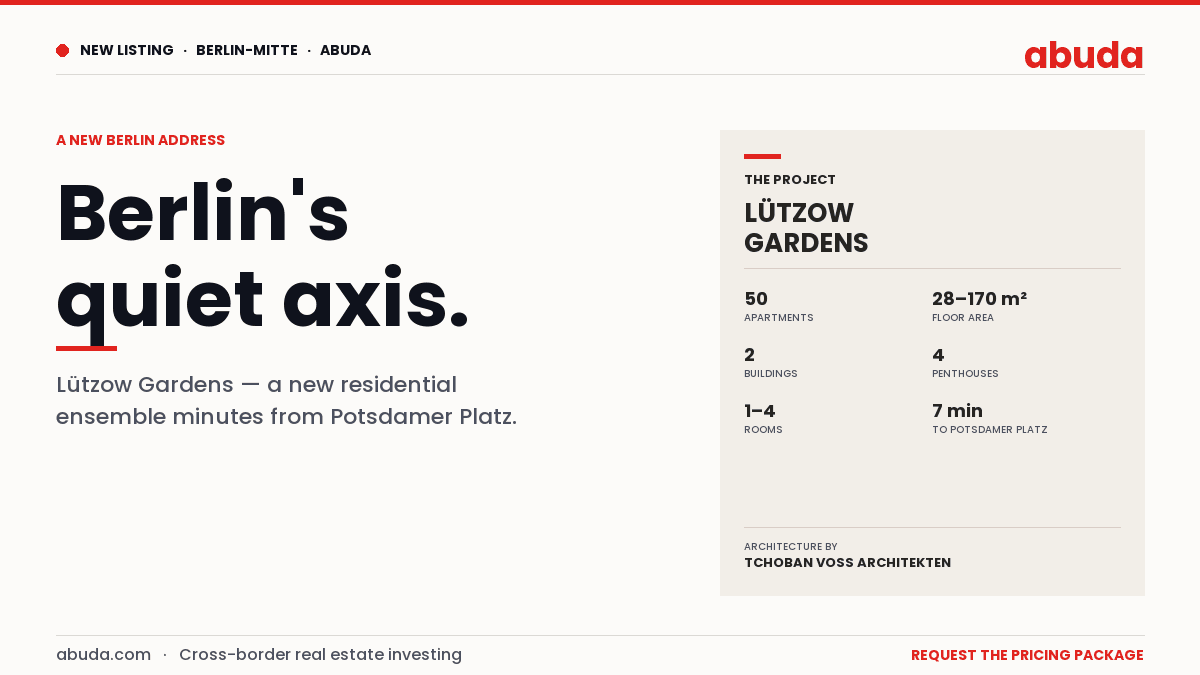
In this piece we lay out why — and we introduce a new residential development that Abuda has just brought onto the platform in one of the city's quietly emerging investment corridors: Lützow Gardens, an ensemble of 50 apartments tucked behind Lützowstraße, minutes from Potsdamer Platz, designed by Tchoban Voss Architekten.
TL;DR — The Berlin Investment Thesis in One Page
Defensive growth backed by a chronic supply shortage. Berlin is structurally short of housing supply versus demand. Prices have continued to appreciate through every European cycle since 2010.
The 10-year tax rule is Germany's hidden weapon. Private investors who hold residential property for at least ten years pay zero capital gains tax on sale. No equivalent exists in most other European jurisdictions.
Yields are modest (2.5%–3.5% gross) but extremely stable. Berlin occupancy runs at 98%–99%+. Vacancy risk is essentially zero in well-located stock.
The Tiergarten / Potsdamer Platz / Kulturforum axis is being redefined. Berlin Modern, the Urbane Mitte quarter at Gleisdreieck, and continued Mitte densification are reshaping the inner-city investment map.
Lützow Gardens — a new residential ensemble behind Lützowstraße — sits in the middle of this axis. Abuda is sourcing units for our cross-border investor base. Pricing on request.
Now the detail.
Why Berlin in 2026
We've covered the full three-way comparison between Limassol, Larnaca, and Berlin elsewhere — see our Q1 2026 Global Investment Matrix article for the side-by-side. Here is the Berlin-only thesis as it stands today.
1. A structural supply shortage that policy cannot fix quickly
Berlin needs roughly tens of thousands of additional residential units per year just to keep up with demand from new population growth, household formation, and the steady inflow of skilled professionals into the city. New completions consistently fall short. This is the single most important reason capital values in Berlin have continued to rise even through periods of rent regulation tightening — supply scarcity dominates everything else in the local pricing equation.
For an investor, this translates into price defence. Even in a stress scenario, you are not competing against a flood of new supply because there is no flood — there is a structural deficit.
2. The 10-year capital gains exemption — Germany's quiet superpower
Germany's tax code contains a provision that genuinely changes how patient capital should think about the market: if a private individual holds residential property for at least ten years, capital gains on sale are completely tax-free under the so-called Spekulationsfrist rule (Income Tax Act §23).
For a private investor who sells a Berlin apartment after at least ten years, the capital gain is taxed at 0%. In Cyprus, the same gain (net of the €30,000 general exemption) would attract 20% Capital Gains Tax. In France or the UK, the differential would be even larger.
This is the lever that makes Berlin work despite the lower yield and higher entry friction. It is not a yield play. It is a tax-efficient compounding play. The longer your horizon, the more the German tax code rewards you.
3. Yield is modest, but occupancy is institutional-grade
Gross rental yields in Berlin sit in the 2.5%–3.5% range in 2026 — lower than they were five years ago, because capital values have risen faster than rents. But occupancy in well-located stock runs at 98%–99%+. The Berlin rental market is so structurally undersupplied that vacancy risk on a properly-positioned apartment is essentially nil.
4. The Mietpreisbremse cap is real — and there are legitimate ways to navigate it
Berlin's rent cap (the Mietpreisbremse) has been extended through 2029. It limits re-letting rents to no more than 10% above the local comparative rent index (Mietspiegel). In practice, the yield-uplift opportunities for Berlin investors lie in two places:
Vacant units at purchase, where initial pricing is not bound by the previous tenancy's regulated rent.
Modernization-linked rent increases, particularly energy-efficiency capex on older stock, which permits regulated rent increases under specific rules.
For a buyer of new-build residential property — like a unit at Lützow Gardens — the Mietpreisbremse complication is meaningfully reduced. New stock attracts its own treatment, and initial rents on first letting are not retrospectively bound by an old reference index.
The Potsdamer Platz / Tiergarten Axis — Berlin's Most Underestimated Investment Corridor
When international investors think Berlin, they think Mitte, Prenzlauer Berg, Kreuzberg, Charlottenburg. But the corridor that runs roughly from Potsdamer Platz north and west through Tiergarten into the Kulturforum / Lützowstraße axis is, in our view, the city's most underpriced inner-city geography in 2026.
What's happening in this part of Berlin right now
Three concrete, scheduled, capital-backed projects are reshaping this part of the city — and pulling forward demand for residential addresses inside the corridor:
Berlin Modern. Designed by the Swiss architecture firm Herzog & de Meuron, Berlin Modern is being built as a new museum for modern and contemporary art, an extension of the Neue Nationalgalerie. €526.5 million budget, scheduled to open in 2029. It will sit on the Kulturforum between the Philharmonie and the Neue Nationalgalerie, creating a continuous cultural campus that runs from Potsdamer Platz westward.
Urbane Mitte am Gleisdreieck. A new urban quarter taking shape around the Gleisdreieck transport hub. Seven distinctive new buildings, ranging from 25 to 90 metres in height, spread across approximately 31,500 sqm. The mix includes offices, a hotel, retail, gastronomy, culture and sports. Critically, Urbane Mitte bridges Park am Gleisdreieck (one of Berlin's most popular green spaces) with the surrounding urban fabric. It's the kind of mixed-use anchor that pulls disposable income and pedestrian traffic into a neighbourhood that previously sat between things rather than in the middle of anything.
Continued Tiergarten densification. Smaller infill projects continue across the Tiergarten side of the corridor, gradually closing the gap between the established Mitte address premium and what is, geographically, the same square mile.
Introducing Lützow Gardens
Against this backdrop, Abuda has brought on Lützow Gardens — a new residential ensemble located behind Lützowstraße in Berlin-Mitte, minutes from Potsdamer Platz, the Tiergarten, and the Kulturforum.
What it is
Two residential buildings arranged around a sheltered, landscaped courtyard garden, comprising 50 apartments ranging from one-room studios to four-room family homes, with floor areas from approximately 28 to 170 square metres. The mix includes 35 ground-floor apartments with direct outdoor access and 4 penthouses.
Every apartment has its own private outdoor space — balcony, terrace, or penthouse deck — and the layouts are designed for contemporary urban living, with open-plan principal rooms and well-defined zones for living, working, and retreat.
The architecture: Tchoban Voss Architekten
Lützow Gardens is designed by Tchoban Voss Architekten — one of Europe's leading architectural practices. Based in Berlin, the studio's portfolio includes the Mall of Berlin, the distinctive nhow Hotel, and the sculptural Museum for Architectural Drawing. Their work has been recognised with the European Prize for Architecture, the International Architecture Award, the German Design Award, and others.
The Lützow Gardens facade is a light natural stone, with finely crafted metal railings and the clear, balanced proportions that have come to define Tchoban Voss's residential work. The visual identity is deliberately calm — the project doesn't shout — but the building presence is precise and confident.
The specification
Open-plan layouts with floor-to-ceiling triple-glazed windows
Oak parquet flooring throughout the principal rooms
Underfloor heating powered by a sustainable energy concept (heat pump and solar)
Lifts in all buildings
Basement storage for every unit
Digital concierge service integrated into the development
A landscaped courtyard with seating and play spaces, plus bicycle parking
Bauträger architecture by Tchoban Voss
For investors thinking about long-hold positions in Berlin, the combination of new-build energy efficiency, certified architecture, and central location is exactly the profile that minimizes future capex risk while maximizing rental defensibility.
The location, walkable
From Lützow Gardens:
1 minute on foot to Concierge Coffee
5 minutes on foot to Park am Gleisdreieck
8 minutes on foot to local shopping
15 minutes on foot to Kurfürstenstraße
7 minutes by transit to Potsdamer Platz
16 minutes by transit to Berlin Central Station (Hauptbahnhof)
25 minutes by transit to Alexanderplatz
29 minutes by transit to Berlin Brandenburg Airport (BER)
4 minutes by car to Potsdamer Platz
This is, in practical terms, Berlin-Mitte without the Berlin-Mitte tourist density. The corridor benefits from inner-city centrality without the daily friction of being on the most-photographed boulevards.
Cultural and lifestyle context
Within an easy walk: the Berliner Philharmonie, the Neue Nationalgalerie, Park am Gleisdreieck, the KaDeWe (Kaufhaus des Westens), the Wochenmarkt Winterfeldtplatz, and a dense cluster of restaurants and bars — Golvet, Irma La Douce, Victoria Bar, The Gibson Bar Berlin, Bonvivant Cocktail Bistro, Café Odor — plus international schools and childcare integrated through the neighbourhood.
For end-user demand (which sets the rental floor for any investor), this combination of green space, cultural infrastructure, and inner-city convenience is exactly what high-credit-quality tenants pay for.
Available Unit Profile
Without disclosing the full pricelist publicly, the available inventory across Lützow Gardens spans:
One-room studio apartments of approximately 28–48 sqm — well-suited to the strong Berlin demand for high-quality single-occupancy and pied-à-terre product.
Two-room apartments of approximately 44–58 sqm — the workhorse of any Berlin yield strategy, with the deepest renter demand pool.
Three-room apartments of approximately 76–112 sqm — appropriate for couples, small families, and long-let furnished-rental positioning.
A small number of penthouse units of 134–169 sqm — the trophy assets of the development, suited to either owner-occupation or high-net-worth long-let.
For Abuda investors interested in unit-level availability, current pricing, payment terms, and a personalized package, the full pricelist is available on request through your Abuda contact.
Frequently Asked Questions
Why invest in real estate in Berlin in 2026?
Berlin combines a structural supply shortage, near-zero vacancy risk (98%–99%+ occupancy in well-located stock), and the German "10-year rule" — a tax provision that lets private holders sell residential property tax-free on capital gains after ten years of ownership. The yield profile is modest (2.5%–3.5% gross), but the after-tax compounding profile over a 10-year-plus hold is one of the strongest in Europe.
What is the 10-year rule in German property?
Under the German Income Tax Act (Einkommensteuergesetz §23), private individuals who hold residential real estate for at least ten years pay zero capital gains tax on the eventual sale. This is the Spekulationsfrist (speculation period) rule, and it is the single biggest tax advantage German real estate offers to long-hold investors.
How does the Mietpreisbremse affect new-build investment apartments?
The Mietpreisbremse rent cap limits re-letting rents on existing tenancies. For new-build residential properties at first letting, the initial rent is set freely — the cap does not retrospectively apply to first-occupation rents in a brand-new building. This is one reason new-build inventory like Lützow Gardens is particularly attractive to investors prioritizing rental yield as well as capital growth.
What is Lützow Gardens?
Lützow Gardens is a new residential development in Berlin-Mitte, tucked behind Lützowstraße and minutes from Potsdamer Platz. It comprises two buildings, 50 apartments (ranging from one-room studios to four-room homes, 28–170 sqm), arranged around a landscaped courtyard. Designed by Tchoban Voss Architekten. Currently in pre-sale through Abuda for our cross-border investor base.
Who is the architect of Lützow Gardens?
Tchoban Voss Architekten, one of Europe's leading architectural practices, based in Berlin. Their notable projects include the Mall of Berlin, the nhow Hotel, and the Museum for Architectural Drawing. The firm holds the European Prize for Architecture, the International Architecture Award, the German Design Award, and FIABCI Prix d'Excellence Germany, among others.
What is the closest U-Bahn or S-Bahn station to Lützow Gardens?
Lützow Gardens is approximately 7 minutes by transit from Potsdamer Platz (U-Bahn / S-Bahn), with direct connections to Berlin Hauptbahnhof (16 minutes), Alexanderplatz (25 minutes), and Berlin Brandenburg Airport (29 minutes). On foot, the property is 1 minute from local cafes and 5 minutes from Park am Gleisdreieck.
Can foreigners buy property in Berlin?
Yes. There are no restrictions on foreign ownership of residential property in Germany, including for non-EU nationals. The purchase process is conducted in front of a German notary (Notar), with a typical 4-8 week timeline from contract signature to completion. Total acquisition costs in Berlin run 10%–12% of purchase price, including the 6% Grunderwerbsteuer (Property Transfer Tax), notary fees, and any agent commission.
Where can I see available units and pricing for Lützow Gardens?
The full unit availability list and pricing are not published publicly — they are released to qualified Abuda investors on request. To receive the full Lützow Gardens package, please contact us at hello@abuda.com, or browse our current Berlin inventory on Abuda.
What's Next
If Berlin is part of your portfolio thesis — or if you've been waiting for the right project to make it part of your portfolio thesis — Lützow Gardens is the cleanest entry point we've brought onto the Abuda platform this year in this part of the city.
Browse available investment apartments in Berlin on Abuda.
See the dedicated Lützow Gardens project page for unit availability, floorplans, and to request the pricing package.
Speak to the Abuda sourcing team at hello@abuda.com for direct access to the project, partnership terms, and our cross-border transaction support.
This article is informational and does not constitute investment, tax, or legal advice. Tax outcomes depend on individual circumstances and should be confirmed with a qualified tax advisor in the relevant jurisdiction. Property markets are subject to volatility and regulatory change.