Buying Guide: Berlin Residential Real Estate Strategic Investment Analysis 2026
A strategic investment analysis of Berlin residential real estate in 2026, covering macro trends, district dynamics, legal process, financing and market outlook.
By abuda, Research Desk · 12 min read
The Macroeconomic Transformation of the German Capital
The Berlin residential real estate market in 2026 stands as a testament to one of the most significant urban economic transformations in modern European history. Once defined by its post-reunification struggles and the famous "poor but sexy" moniker coined in 2003, the city has definitively transitioned into a mature, high-output economic metropolis that serves as the undisputed technological and administrative heart of the European Union. This evolution is not merely anecdotal; it is supported by a structural shift in the city's GDP, labor market composition, and its role as a global magnet for venture capital. For the institutional or private investor, understanding Berlin in 2026 requires moving beyond the surface-level metrics of price appreciation to analyze the underlying drivers of demand, the persistent supply-side constraints, and the shifting regulatory landscape that governs property ownership in Germany.
The Economic Engine: Venture Capital and the Startup Ecosystem
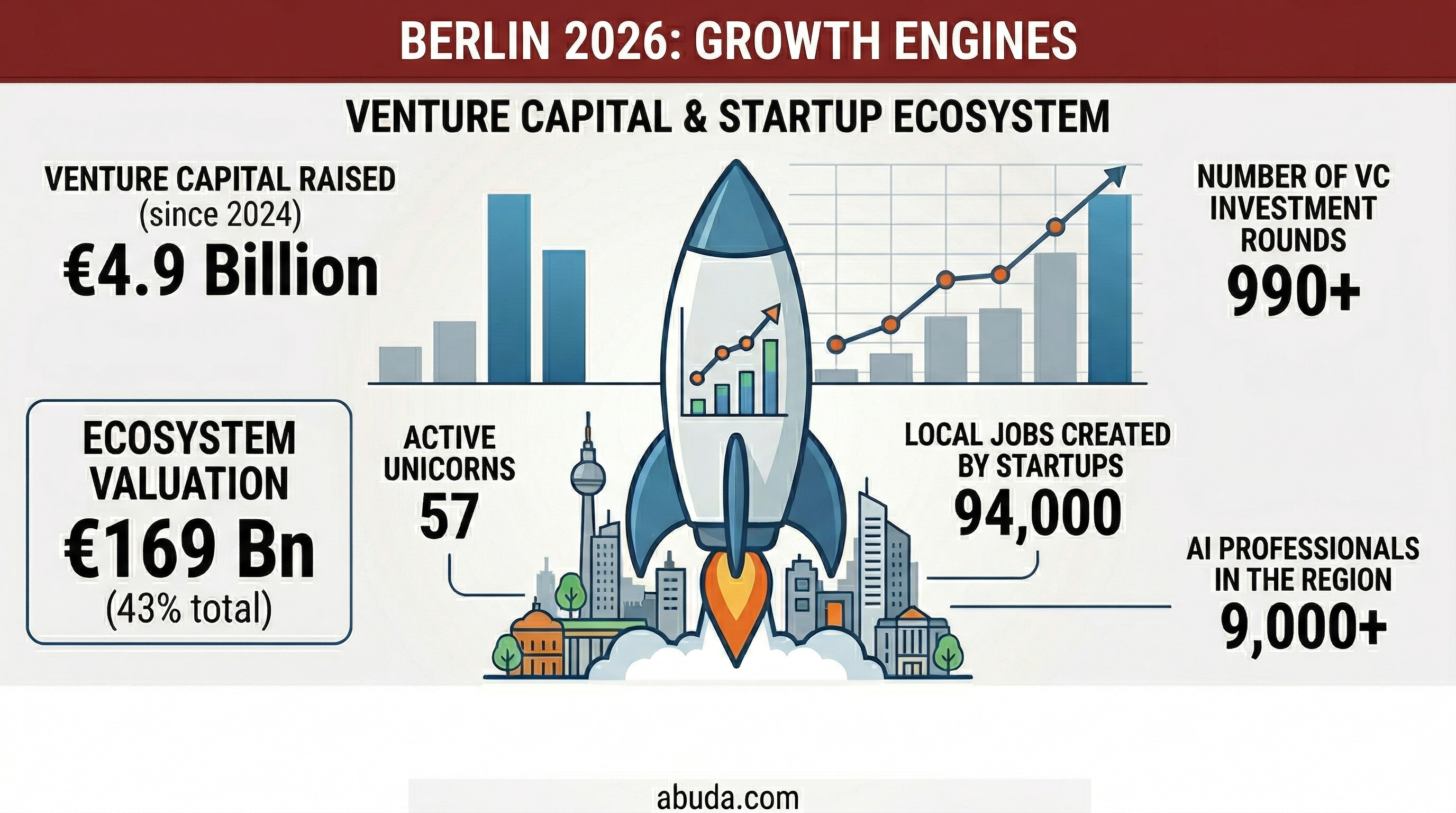
The primary catalyst for Berlin's sustained residential demand is its status as a leading global hub for innovation. As of early 2026, Berlin’s startup ecosystem is valued at a combined €169 billion, representing a staggering 43% of the total value of the entire German startup landscape. This concentration of economic value in a single city creates a unique "founder factory" effect, where former employees of established unicorns like Zalando, Delivery Hero, and N26 go on to launch their own ventures, creating a self-sustaining cycle of wealth and high-income employment.
The velocity of this ecosystem is remarkable; current data indicates that a new startup is founded in Berlin every 14 hours. This pace of innovation directly translates into housing demand, as these companies attract a highly mobile, international workforce that requires premium rental housing and, increasingly, seeks to enter the homeownership market. The following table illustrates the scale of this economic driver:
Key Ecosystem Metric | 2025/2026 Data Value | Regional Rank/Context |
|---|---|---|
Total Ecosystem Valuation | €169 Billion | 43% of Germany’s Total |
Venture Capital Raised (since 2024) | €4.9 Billion | #4 in Europe |
Number of VC Investment Rounds | 990+ | #2 in Europe |
Total Active Unicorns | 57 | Includes Auto1, Trade Republic |
Local Jobs Created by Startups | 94,000 | High concentration of expat talent |
AI Professionals in the Region | 9,000+ | Top 3 AI Hub in Europe |
This economic resilience is particularly evident in sectors such as Fintech, Enterprise Software, and ClimateTech, the latter of which has raised over €800 million in venture capital since 2024 alone. For real estate investors, this data signals a permanent shift in the demographic profile of the Berlin tenant: they are younger, more international, and significantly higher-earning than the city's historical average. This shift is most pronounced in central districts like Mitte and Friedrichshain-Kreuzberg, where the "flight to quality" is the dominant market theme.
Demographic Dynamics: The 3.9 Million Milestone
The fundamental thesis for any residential real estate investment is demographic pressure. Berlin's population has reached a historic peak, standing at 3,913,644 residents as of December 31, 2025. This represents a steady, albeit moderate, growth trajectory that continues to outpace the city’s ability to provide new housing. To understand the 2026 market, one must analyze the nuances of this growth, which is increasingly driven by internal migration and political naturalization rather than the raw international influx seen in the mid-2010s.
Migration Patterns and the "Naturalization Effect"
A critical observation from the 2025-2026 data is the decline in direct registrations from abroad. In 2025, only 4,541 people from abroad registered as new residents, a significant drop from the 25,500 recorded in 2024. However, the total population continued to rise by 16,500 people during the same period. This discrepancy is explained by a "naturalization effect," where a political decision to speed up naturalization procedures led to a record number of residents receiving German passports. This is a vital insight for investors: while "foreign migration" numbers may appear lower on the surface, the actual demand for housing remains high as these newly naturalized citizens transition into long-term, stable residents who are more likely to seek permanent homeownership.
Furthermore, the city's internal demographics show an increasing "growth gap" between its eastern and western sectors. The eastern districts gain population at a rate of 0.9%, while the west grows at only 0.1%. This trend is reshaping the investment map, pushing capital toward districts like Treptow-Köpenick and Lichtenberg, which offer more favorable entry prices and higher growth potential than the saturated western hubs.
District Growth Highlights (2025) | Population Change | Migration Background % |
|---|---|---|
Treptow-Köpenick | +1.8% (5,450 people) | High gain in Adlershof |
Mitte | Stable Growth | 42.3% city-wide avg |
Reinickendorf | -0.9% Decline | Impact of Tegel closure |
Steglitz-Zehlendorf | -0.2% Decline | Aging demographic |
The demographic pressure is not uniform. The "lock-in effect" of older, low-rent contracts means that as the population grows, the available supply of vacant units for new residents is virtually non-existent, with a vacancy rate holding at a critical 0.3%.
The Housing Supply Crisis: A Perfect Storm
The 2026 Berlin market is defined by a "perfect storm" of high demand and a complete stagnation in new construction. Despite the Berlin Senate’s 2024 "Faster Building Act," which aimed to reduce bureaucracy, the physical reality of construction completions remains grim. High interest rates (3.5% to 5.0%), skyrocketing material costs (up 35% since 2020), and a chronic shortage of skilled labor have made many planned developments unproftable.
Construction Volatility and the Permit Slump
Real construction volume in Germany is expected to fall for the fifth consecutive year in 2026, ending up 25% below 2020 levels for new residential units. In Berlin specifically, building permits for residential units collapsed by 38.5% in 2024, continuing a downward trend that began in 2017. This lack of new permits is a leading indicator that the housing shortage will not only persist but likely intensify through the late 2020s.
Supply Metric | 2024/2025 Actual | 2026 Projection |
|---|---|---|
Completed Units (Berlin) | 15,362 | Expecting a low point |
Building Permits (Berlin) | 9,772 | Sustained downward trend |
National Completion Goal | 400,000 | Projected only 185,000 |
Backlog of Unrealized Projects | 760,000 (National) | Permits expiring unused |
This supply deficit has profound implications for asset values. While the "Survive till '25" motto helped many market participants navigate the 2022-2024 rate shock, the 2026 market is seeing a return to nominal price growth as the sheer lack of alternatives forces buyers back into the market.
Buying Guide: The Legal and Procedural Framework
Investing in Berlin requires a meticulous understanding of the German legal system, which is structured to provide high levels of transparency and consumer protection. The process is centralized around the public notary (Notar), a neutral official who ensures the legal validity of the transaction.
The 8-Step Acquisition Process for International Investors
For the international buyer, the process typically spans 3 to 5 months, accounting for the additional time required for international document verification and potential mortgage approval.
Reservation and Legal Due Diligence: Once a property is identified, a reservation fee (usually 0.5% to 1.0% of the purchase price) is paid to secure the unit for up to four weeks. During this time, it is imperative to conduct a thorough legal and technical review of the property, including the Grundbuch (Land Register) records and the Teilungserklärung (Declaration of Division) for apartments.
Mandating a German Lawyer (POA): It is strongly advised for international buyers to mandate a German attorney. This lawyer can act as an authorized recipient for legal documents, provide a domestic address for tax purposes, and act on the buyer's behalf via Power of Attorney (POA) if they cannot be physically present for the signing.
The Draft Contract: The notary drafts the Kaufvertrag (Purchase Agreement). Under German consumer protection law, the buyer must receive this draft at least 14 days before the signing meeting to allow for adequate review.
Financing and Mortgage Offer: While preliminary offers are sourced early, the final binding mortgage contract is typically finalized once the purchase contract draft is issued. German banks are generally willing to finance international buyers, though with higher equity requirements (usually 40-50% for non-residents).
The Notarization Meeting: The seller and buyer (or their POA representatives) meet at the notary’s office. The notary reads the entire contract aloud in German. If any party does not speak fluent German, a certified interpreter must be present to translate the proceedings.
Priority Notice in the Land Register: Immediately after signing, the notary registers an Auflassungsvormerkung (Priority Notice of Conveyance) in the Grundbuch. This "locks" the property, preventing the seller from selling it to anyone else or encumbering it with new debts.
Payment of Transaction Costs and Purchase Price: Once the priority notice is in place and the "Payment Due Notice" is issued by the notary, the buyer pays the purchase price (often via a notary escrow account). Simultaneously, the ancillary costs—transfer tax, notary fees, and brokerage commissions—must be settled.
The Final Inspection and Handover: For new constructions, a professional inspector is recommended to ensure the property meets all contractual specifications before the final installment is paid and keys are handed over.
The Makler- und Bauträgerverordnung (MaBV) Payment Plan
For properties purchased "off-plan" or during construction, the Makler- und Bauträgerverordnung (MaBV) provides a statutory framework that prevents developers from taking payment before work is completed. This protection is a cornerstone of the German development market.
Construction Milestone | Max Installment % | Cumulative Payment |
|---|---|---|
After start of earthworks | 30.0% | 30.0% |
After completion of structural frame | 28.0% | 58.0% |
After roof surfaces and window installation | 12.6% | 70.6% |
After basic rough-in (heating/plumbing/elec) | 6.3% | 76.9% |
After interior plastering and screed | 9.1% | 86.0% |
After facade and readiness for occupancy | 10.5% | 96.5% |
After final completion (no defects) | 3.5% | 100.0% |
If a developer requests payments that deviate from these stages, the agreement is legally void. This ensures that the buyer’s capital is always backed by physical progress on the site.
Financial Architecture: Taxes, Fees, and Commissions
In 2026, the cost of entry into the Berlin market includes a significant layer of ancillary expenses. A crucial development is the potential rise in the property transfer tax (Grunderwerbsteuer). While it has been 6.0% since 2014, the Berlin Senate has been debating a hike to 6.5% to bridge budget gaps.
Transaction Cost Breakdown
Buyers should budget between 10% and 13% of the purchase price for total closing costs when using a broker and a mortgage.
Cost Component | Rate in 2026 | Who Pays / Note |
|---|---|---|
Real Estate Transfer Tax | 6.0% - 6.5% | Buyer; Due after notarization |
Notary Fees | 1.5% - 2.0% | Buyer; Based on statutory fee schedule |
Land Registry Fees | ~0.5% | Buyer; Fixed court registration costs |
Real Estate Agent Fee | 3.57% (inc. VAT) | Shared 50/50 for residential consumer buys |
Legal/Technical DD | €2,000 - €5,000 | Recommended for older or complex assets |
The 2020 Brokerage Law Reform
Investors must be aware that since December 2020, the commission structure for apartments and single-family houses sold to private individuals has changed significantly. In Berlin, it was historically common for the buyer to pay the full 7.14% commission. Today, the law mandates a 50/50 split between buyer and seller. However, this law does not apply to commercial properties or entire multi-family apartment blocks sold as investment vehicles, where the commission remains a matter of negotiation and can still be borne entirely by one party.
Financing and Mortgage Strategies for 2026
The mortgage market in Germany has stabilized in early 2026 after the volatility of 2022-2023. While the era of 1% interest rates is over, the current environment of 3.5% to 5.0% for fixed-rate loans is considered balanced by historical standards.
Underwriting Criteria for International Buyers
German banks typically differentiate between "residents" (those with local income/residency) and "non-residents." For the international investor, the following parameters generally apply:
Loan-to-Value (LTV): Non-residents are often capped at 50% to 60% LTV. This means the investor must provide 40-50% of the purchase price as equity, plus 100% of the ancillary closing costs from their own funds.
Affordability: Banks use a rule of thumb where the monthly mortgage payment should not exceed 40% of the applicant's net monthly income.
Repayment (Tilgung): Most German mortgages are "annuity" loans where the borrower pays interest plus a principal repayment of 1% to 3% per year.
Interest Fixation: A unique feature of the German market is the long-term fixation, typically for 10, 15, or 20 years, providing investors with long-term cash flow predictability.
Loan Fixation Period | Avg Interest Rate (2026) | Typical Repayment Rate |
|---|---|---|
5 Years | ~3.77% | 2.0% |
10 Years | ~3.91% | 2.0% |
15 Years | ~4.19% | 2.0% |
20 Years | ~4.33% | 2.0% |
District Analysis: Where to Invest in 2026
Berlin's decentralized structure means that different neighborhoods offer vastly different risk-return profiles. In 2026, the city can be divided into "Prime Core," "Established Family," and "Growth Frontier" districts.
Mitte: The Premium Hub
Mitte is the administrative and cultural heart of Berlin. It remains the top choice for international expats and high-income professionals. New-build developments here, such as those in the Europacity area near the main station, command prices between €10,000 and €14,000 per square meter. The district benefits from ongoing infrastructure projects like the S21 rail extension, which has already triggered modest price increases of 3% to 8% in nearby blocks.
Treptow-Köpenick: The Rising Star
In terms of population growth, Treptow-Köpenick is the clear outperformer in 2025-2026. Its appeal lies in its combination of high-tech employment (the Adlershof Science Hub) and exceptional natural amenities (lakes and parks). Planning areas like Oberspree and Adlershof have seen population gains of 9% to 27%, making them targets for investors seeking potential long-term capital appreciation and stable family rentals.
Neukölln and Wedding: The Gentrification Play
These districts continue to see strong demand from younger professionals and the creative class. Neukölln, in particular, has seen its northern parts (Nord-Neukölln) transform into a high-demand rental market, with mid-range one-bedroom apartments fetching between €800 and €1,000 per month. Prices here remain more accessible than in Mitte or Charlottenburg, ranging from €3,800 to €6,000 per square meter, offering a compelling value-to-location proposition.
District | Avg Resale Price (/m2) | New Build Price (/m2) | Avg Rent (/m2 cold) |
|---|---|---|---|
Mitte | €6,000 - €9,000 | €10,000 - €14,000 | €18 - €22 |
Charlottenburg | €5,500 - €8,800 | €9,500 - €13,000 | €16 - €20 |
P. Berg/Pankow | €5,000 - €8,000 | €9,000 - €11,000 | €17 - €21 |
F-hain/K-berg | €5,500 - €8,500 | €8,500 - €10,500 | €16 - €19 |
Neukölln | €3,800 - €6,000 | €6,500 - €8,500 | €14 - €17 |
T-Köpenick | €3,700 - €5,800 | €6,000 - €8,000 | €12 - €15 |
Spandau | €3,200 - €4,800 | €5,000 - €6,500 | €10 - €12 |
The Rental Market: Regulation and Performance
Berlin’s rental market is highly regulated, a fact that is central to any investment strategy. The city is a "tenant's market" in terms of legal rights but a "landlord's market" in terms of scarcity.
The Lock-in Effect and the Rent Gap
There is a massive spread between existing rents in long-term contracts and the price of new lettings on the free market. While long-term tenants might pay as little as €7.67 per square meter, new contracts for existing units average €16.35, and new-build rentals often exceed €22.00. This creates a "lock-in effect" where tenants simply do not move, leading to an annual turnover rate of less than 2%. For property owners, this means that vacant apartments are exceptionally rare and highly valuable.
Rental Yield Analysis
Gross rental yields in Berlin typically range from 3.5% to 4.5% in 2026. While these yields are lower than in some other European cities, they are underpinned by extremely low vacancy risk and high potential for capital growth due to the construction crisis.
Apartment Type | Avg Cold Rent (Monthly) | Typ. Unit Size (m2) | Monthly Budget Range |
|---|---|---|---|
Studio | €800 - €820 | 35 - 40 | €550 - €1,100 |
1-Bedroom | €1,050 | 50 | €750 - €1,400 |
2-Bedroom | €1,650 | 75 | €1,200 - €2,200 |
3-Bedroom | €1,400 (Avg) | 95 | €1,400 - €2,200 |
Note: The 3-bedroom average rent often appears lower than 2-bedroom averages because these larger units are more frequently found in outer districts or older Plattenbau buildings.
Holding Costs and Taxation of Ownership
Owning real estate in Berlin carries ongoing fiscal responsibilities. Non-resident owners are required to file a German tax return annually.
Property Tax (Grundsteuer): This is a quarterly municipal tax. For a standard apartment, it typically costs between €80 and €150 per year. A major reform of the Grundsteuer calculation is ongoing in 2025/2026, which may lead to adjustments in the assessed values.
Income Tax on Rent: Non-residents are taxed on their German-source rental income at progressive rates starting from 14.77%. However, investors can deduct mortgage interest, property management fees, insurance, and maintenance costs.
Building Depreciation (AfA): Owners can write off 2% to 3% of the building’s value (excluding land) annually as a depreciation expense, significantly reducing the taxable income. For residential buildings completed after 2022, the linear depreciation rate is 3%.
Capital Gains Tax (CGT): If the property is held for more than 10 years, the profit from the sale is entirely tax-free for individuals. This is one of the most significant incentives for long-term investment in German real estate.
Future Infrastructure and Market Catalysts
Strategic investors should monitor several large-scale infrastructure projects that will shape Berlin’s urban geography over the next decade.
The S21 Rail Link: This project, with phases completing through 2026 and beyond, will create a vital north-south connection through the central station, which may increase the accessibility and value of districts like Wedding and northern Mitte.
Tegel Urban Tech Republic: Following the closure of the airport, this site is being transformed into a major research and industrial park focused on urban technologies. It is a long-term catalyst for the Reinickendorf district, which is currently seeing a temporary population dip but may have upside potential as the project scales through 2027-2030.
A100 Motorway Extension: The progression of the A100 ring road through Friedrichshain and Treptow is improving logistics and accessibility for the city’s eastern flank, further supporting the growth of the Mediaspree area.
ESG and Energy Efficiency: The New Standard
A dominant trend in the 2026 market is the "Green Premium." Apartments and houses with high energy efficiency (Class A or B) are increasingly seen as the most liquid and future-proof assets. Owners of older properties are under increasing pressure to modernize heating systems and windows to comply with stricter environmental standards. For investors, this means that an Altbau property with a modern energy rating can command a price premium over unrenovated counterparts.
Strategic Conclusion and Investment Outlook
The Berlin residential real estate market in 2026 presents a rare profile of high stability and chronic undersupply. The combination of a world-class technology ecosystem, a population that has reached 3.9 million, and a construction industry that is essentially at a standstill creates a fundamental floor for property values.
While the upfront acquisition costs are high—ranging from 10% to 13%—the long-term benefits of tax-free capital gains after 10 years and a virtually non-existent vacancy risk make it a cornerstone for any diversified European portfolio. Investors should prioritize "quality-adjusted" assets in central districts or target the clear demographic winners in the east like Treptow-Köpenick. The 2026 market is no longer about speculative gambling but about disciplined capital allocation into an urban environment that is structurally short of its most basic necessity: housing. The "Buying Guide" for 2026 is clear: secure assets now, utilize long-term fixed financing, and capitalize on the city's transition into a global innovation powerhouse.